The most relevant tesamorelin-versus-CJC question is not a two-product comparison. It is a three-way comparison.
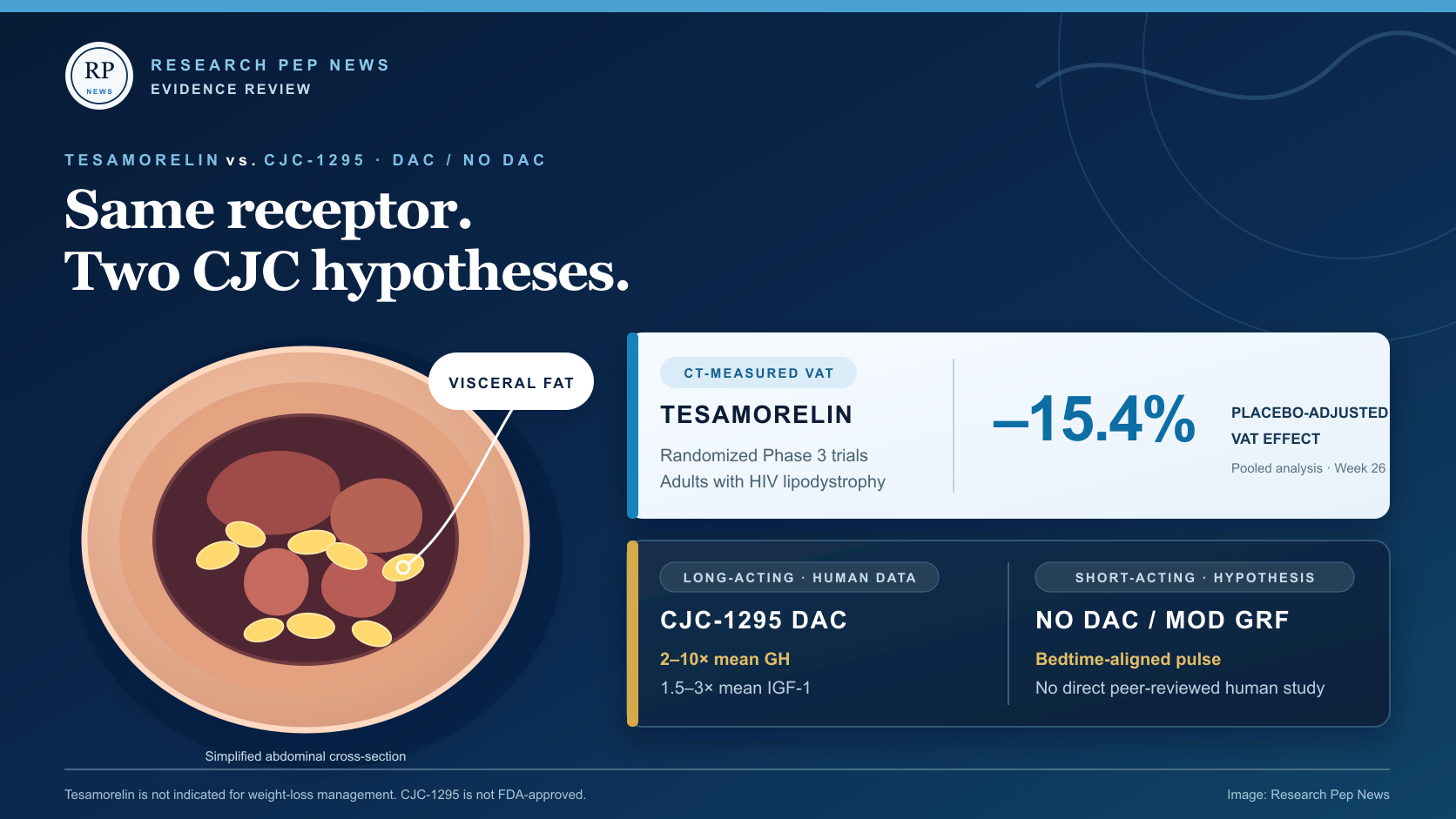
Tesamorelin has randomized human trials showing a reduction in visceral adipose tissue. Long-acting CJC-1295 with a drug affinity complex, or DAC, has small human studies documenting sustained increases in growth hormone and IGF-1. The product commonly called “CJC-1295 without DAC” or Mod GRF 1-29 sits at the center of a different community hypothesis: that a short-acting GHRH signal timed near sleep may amplify a natural GH pulse without keeping trough GH continuously elevated.
All three approaches target the pituitary GHRH receptor. All are intended to increase endogenous growth hormone rather than supply recombinant GH directly. The timing and duration of that signal may be materially different.
That creates two related hypotheses:
The shared-pathway hypothesis: If either CJC form reproduces the biologically relevant GH and IGF-1 exposure associated with tesamorelin’s visceral-fat response, it may produce some of the same effect.
The no-DAC timing hypothesis: A short-acting Mod GRF 1-29 signal near sleep may align with the body’s major nocturnal GH pulse more closely than long-acting CJC-1295 DAC. This is a physiologically grounded community proposal, not a result established in a peer-reviewed no-DAC trial.
The hypotheses are credible enough to study and precise enough to be proven wrong.
First, “with DAC” and “without DAC” are not interchangeable
The original CJC-1295 molecule was engineered from the active 1-29 fragment of human GHRH. It includes four amino-acid substitutions that improve stability and a reactive group designed to bind albumin after injection. That albumin-binding technology is the drug affinity complex.
In the original preclinical paper, researchers identified CJC-1295 itself as the long-acting albumin-binding compound. The phrase “CJC-1295 with DAC” is therefore somewhat redundant in the scientific literature.
The research market uses “CJC-1295 without DAC” for a related short-acting peptide also called Mod GRF 1-29 or modified GHRH 1-29. That label is familiar and useful for readers, but it should not imply that the human CJC-1295 DAC results automatically transfer to the no-DAC product.
FDA’s 2024 review searched CJC-1295-related free-base, acetate, DAC and salt forms separately. The agency found that the published healthy-adult studies appeared to involve a CJC-1295 DAC active moiety, although the salt was not specified. FDA did not identify peer-reviewed human studies of the separately nominated CJC-1295 free base or acetate forms associated with the no-DAC category.
That does not establish inactivity. It means the direct human pharmacokinetic and hormone-response record belongs to DAC, not to every product sold under the CJC-1295 name.
The three-way comparison at a glance
- Tesamorelin: Daily GHRH analog with randomized, CT-measured visceral-fat outcomes and an FDA-approved indication for excess abdominal fat in adults with HIV-associated lipodystrophy.
- CJC-1295 DAC: Long-acting, albumin-binding GHRH analog with published human GH and IGF-1 data. No completed published visceral-fat efficacy result.
- “CJC-1295 no DAC” / Mod GRF 1-29: Short-acting GHRH analog central to the bedtime-pulse hypothesis. No direct peer-reviewed human PK, GH/IGF-1 or visceral-fat study for the marketed no-DAC substance was identified by FDA.
Neither tesamorelin nor either CJC form is technically a classic GHRP. GHRPs such as ipamorelin signal through the ghrelin receptor. Tesamorelin and the CJC-related peptides are GHRH-receptor agonists.
What tesamorelin establishes
Tesamorelin’s pivotal evidence came from two 26-week, randomized, placebo-controlled Phase 3 trials involving 806 adults receiving antiretroviral therapy for HIV who had excess abdominal fat.
In the pooled analysis, tesamorelin produced a 15.4% placebo-adjusted reduction in CT-measured visceral adipose tissue at Week 26. The two individual trials in the current FDA label reported mean visceral-fat changes of –18% and –14% with tesamorelin, compared with +2% and –2% with placebo.
One Phase 3 analysis also links endocrine activation to body composition. At Week 26, IGF-1 increased by an average of 109 ± 113 ng/mL with tesamorelin, compared with a decline of 16 ± 66 ng/mL with placebo. Visceral fat decreased by 15% with tesamorelin and increased by 5% with placebo. The IGF-1 change was modestly but significantly associated with the change in visceral fat.
In a separate responder analysis, participants who lost at least 8% of their visceral fat had an average IGF-1 increase of 136 ng/mL, compared with 85 ng/mL among nonresponders at Week 26. The marker tracked with response without perfectly predicting it.
Tesamorelin has also reduced visceral fat in a smaller randomized trial of adults with abdominal obesity and reduced GH secretion who did not have HIV. Over 12 months, IGF-1 rose by 86 μg/L with tesamorelin and declined by 6 μg/L with placebo; the estimated treatment effect on visceral fat was –35 cm².
These findings establish the outcome and strengthen the pathway logic. They do not create a general weight-loss indication. Tesamorelin was weight-neutral in its pivotal trials and did not significantly reduce abdominal subcutaneous fat.
What CJC-1295 DAC establishes
The best-known randomized CJC-1295 study tested a long-acting GHRH analog in healthy adults. It measured hormone exposure rather than fat loss.
After one injection, mean GH concentrations increased two- to tenfold for six days or longer, depending on dose. Mean IGF-1 increased 1.5- to threefold for nine to 11 days. After repeated doses, mean IGF-1 remained above baseline for as long as 28 days. The estimated half-life was 5.8 to 8.1 days.
A second human study examined overnight GH secretion one week after a single CJC-1295 injection. GH pulses remained present. Basal, or trough, GH increased 7.5-fold, mean GH increased 46%, and IGF-1 increased 45%.
That pattern is more nuanced than “continuous GH.” CJC-1295 DAC preserved GH pulses, but it placed those pulses on a substantially elevated trough. The study confirms a durable, biologically active signal. It does not show how that pattern changes visceral fat over months.
The DAC evidence makes the shared-pathway hypothesis reasonable: a compound that produces sustained GH and IGF-1 elevations could plausibly influence visceral adipose tissue. The size of that effect remains unmeasured.
What the no-DAC version is trying to do differently
The no-DAC concept is not simply “cheaper CJC.” Its appeal comes from timing and pulsatility.
A short-acting GHRH analog is intended to create a temporary pituitary signal and then clear, leaving more of the day near baseline. Community protocols often place that signal in a fasted period near bedtime, with the goal of amplifying rather than replacing the GH pulse associated with early sleep.
That rationale starts with confirmed human physiology. In adults, the most reproducible GH pulse occurs shortly after sleep onset and is associated with the first period of slow-wave sleep. Sleep state also affects the response to GHRH: a controlled study found that nocturnal wakefulness strongly inhibited GH secretion induced by an intravenous GHRH challenge.
There is also clinical precedent for a short-acting GHRH analog at night. In a randomized trial in older adults, nightly [Nle27]GHRH-(1-29)-NH2 administered at 9 p.m. produced an acute GH release within 10 minutes that lasted about two hours. Integrated nocturnal GH and serum IGF-1 increased during treatment.
That study did not test CJC-1295 no DAC, did not measure visceral fat by CT and did not validate a community dosing protocol. It shows that a short GHRH 1-29 analog can produce a transient nocturnal GH signal in humans—the physiological bridge that makes the no-DAC hypothesis interesting.
Does “fasted before bed” make the signal more natural?
The sleep portion of the hypothesis is better supported than the specific fasting protocol.
Oral glucose can suppress spontaneous GH and alter the response to a GHRH challenge in healthy adults. Longer fasting also increases total and pulsatile GH secretion. These findings support the general idea that nutrient state influences the GH axis.
They do not establish a required number of fasting hours before a no-DAC injection, and the glucose effect changes with timing. In one human study, glucose inhibited a GHRH response when given 30, 60 or 120 minutes earlier, then enhanced the response when GHRH was given 180 minutes later.
Community protocol, not clinical fact: No-DAC is often timed in a fasted state near bedtime with the intention of aligning a short GHRH signal with early sleep and avoiding an immediate nutrient-related suppression of GH. No peer-reviewed human study has tested that exact CJC-1295 no-DAC protocol.
“Designed to align with the natural rhythm” is accurate. “Proven to mimic the natural rhythm” is not yet supported.
Which pattern should matter more for visceral fat?
The decisive biological variable may not be a single IGF-1 result. Total GH exposure, pulse amplitude, trough concentration, time above baseline and treatment duration could all matter.
GH is the more direct lipolytic signal. In a randomized human crossover experiment, an acute GH exposure increased circulating free fatty acids and altered several regulators of lipolysis inside adipose tissue. Randomized recombinant-GH trials in abdominally obese adults have also reported reductions in CT-measured visceral fat.
IGF-1 acts as a useful dashboard gauge for cumulative activation of the GH axis. Tesamorelin trials show an association between larger IGF-1 increases and visceral-fat response. IGF-1 remains an incomplete surrogate because people with similar serum results can have different GH pulse patterns, baseline secretion and tissue sensitivity.
That creates three competing possibilities:
- Total exposure dominates. Long-acting DAC could produce a visceral-fat effect through sustained GH and IGF-1 elevation.
- Physiologic timing matters. Short-acting no-DAC could produce a meaningful effect by repeatedly amplifying a nocturnal pulse while allowing low troughs.
- The patterns are not equivalent. Similar IGF-1 values could conceal different adipose, glucose or safety outcomes.
All three are compatible with the evidence available today.
Can the existing hormone numbers be compared directly?
No published study has measured tesamorelin, CJC-1295 DAC and no-DAC under the same conditions.
The CJC-1295 DAC studies used healthy adults, weight-based doses, short observation periods and intensive GH sampling. Tesamorelin trials used daily treatment for months in adults with abdominal fat accumulation and measured clinical outcomes. The no-DAC product lacks a direct peer-reviewed human hormone-response dataset.
A two- to tenfold GH rise with DAC cannot be converted into an expected percentage of visceral-fat loss. An IGF-1 increase of 109 ng/mL with tesamorelin cannot establish that its hormone exposure is uniquely effective. A transient bedtime pulse from a different GHRH 1-29 analog cannot be assigned to every vial labeled CJC-1295 no DAC.
The same-receptor hypothesis survives these limitations. Numerical equivalence does not.
The visceral-obesity study that never answered the question
A randomized, placebo-controlled Phase 2 trial was registered to evaluate CJC-1295 in 120 people with HIV-associated visceral obesity. Participants were assigned to low-dose CJC-1295, high-dose CJC-1295 or placebo for 12 weeks.
The study was terminated, and no outcome results were posted. The registry does not provide the result needed to compare CJC-1295 with tesamorelin or to distinguish DAC from no-DAC effects.
Its existence still matters. Researchers considered the GHRH-pathway argument credible enough to advance CJC-1295 into a visceral-obesity trial. The unanswered question is a gap in execution, not a biologically incoherent proposal.
What the decisive study should look like
The best study would include four groups: tesamorelin, a precisely characterized CJC-1295 DAC product, a precisely characterized no-DAC/Mod GRF 1-29 product and placebo.
The primary endpoint should be CT- or MRI-measured visceral adipose tissue at approximately 26 weeks. Frequent overnight sampling should compare GH pulse amplitude, trough, total exposure and timing. IGF-1 should be tracked as an age-adjusted concentration and over time. Glucose control, fluid retention, joint symptoms, injection-site reactions and antibody formation should be monitored prospectively.
The design could test whether matched IGF-1 exposure produces matched visceral-fat loss—and whether a pulse-centered no-DAC pattern behaves differently from a sustained DAC pattern.
That trial would do more than rank products. It would test which feature of the GH signal actually matters.
What can be concluded now
Tesamorelin owns the clinical outcome: randomized visceral-fat reduction in a defined population.
CJC-1295 DAC owns the published CJC human hormone data: sustained GH and IGF-1 elevation with preserved pulses and a raised trough.
“CJC-1295 no DAC” owns the community’s most relevant timing hypothesis: a short GHRH signal aligned with early sleep may preserve a more pulse-centered pattern. Related GHRH research makes that idea physiologically plausible. The marketed no-DAC substance itself lacks the human evidence needed to quantify the hormone response or predict visceral-fat loss.
Price and accessibility make both CJC hypotheses consequential. They do not answer them. A lower-cost approach that reproduces a meaningful visceral-fat effect would matter; the evidence does not yet identify which CJC pattern, if either, accomplishes that.
The next useful conversation is no longer “tesamorelin has data and CJC-1295 does not.” It is this:
Does visceral fat respond primarily to total GH/IGF-1 exposure, or does the pattern of that exposure—sustained DAC signaling versus a short nocturnal no-DAC pulse—change the result?
That is a biohacking-community hypothesis grounded in confirmed human endocrinology and waiting for the right human trial.
Source record
- FDA prescribing information for EGRIFTA WR (tesamorelin), revised March 2025
- Pooled analysis of two Phase 3 tesamorelin trials
- Tesamorelin trial linking changes in IGF-1 and visceral fat
- Tesamorelin responder analysis of IGF-1 and visceral-fat change
- Randomized tesamorelin trial in abdominal obesity with reduced GH secretion
- Original identification and albumin-binding design of CJC-1295
- Randomized CJC-1295 DAC pharmacokinetic and pharmacodynamic study
- CJC-1295 DAC growth-hormone pulsatility study
- FDA’s 2024 review of CJC-1295-related substances
- Physiology of growth-hormone secretion during sleep
- Human study of sleep state and GHRH-stimulated GH secretion
- Randomized nightly GHRH 1-29 analog trial in older adults
- Human study of oral glucose and GHRH-stimulated GH release
- Human study of fasting and pulsatile GH secretion
- Randomized human study of GH signaling and lipolysis in adipose tissue
- Randomized GH trial in men with abdominal obesity
- ClinicalTrials.gov record for the terminated CJC-1295 visceral-obesity study
Research Pep News provides news and educational information, not individualized medical advice. Tesamorelin is FDA-approved only for the reduction of excess abdominal fat in adults with HIV-associated lipodystrophy. CJC-1295-related products are not FDA-approved.
This staff report was prepared for Research Pep News and is presented as news and educational information, not medical advice.