Two prominent peptide conversations appear to point in opposite directions.
Discussing oral BPC-157 with physician Craig Koniver, Andrew Huberman said, “It’s a gut peptide. We don’t have to worry about it being destroyed by the gut.” Koniver answered that the oral form seemed most useful in the gastrointestinal tract in his clinical experience, while acknowledging that controlled human evidence was missing.
On Mind Pump, physician and peptide researcher William Seeds was much more skeptical about oral peptide bioregulators. “My opinion is it’s a big marketing ploy,” he said. Yet only minutes later, Seeds named BPC-157 among the unusual peptides he believed could work through the oral route: “BPC-157 is one of the few.”
That is not really a contradiction. It is the beginning of a better rule.
“Oral peptide” is not one pharmacological category. A 15-amino-acid peptide from gastric-juice research, a three-amino-acid sequence that can use an intestinal transporter, a four-amino-acid bioregulator and a 31-amino-acid drug packaged with an absorption enhancer do not face the same biology. Each molecule and formulation has to be tested on its own.
The direct answer: BPC-157 has more evidence for oral plausibility than most research peptides because it resists degradation in simulated gastric juice and has produced biological effects when given orally in animal studies. That clears an important first gate. It does not establish human oral bioavailability, systemic tissue exposure or clinical efficacy. FDA reviewers found no human pharmacokinetic data after oral BPC-157 and no oral study in ulcerative colitis, the use the agency evaluated. Commercial peptide bioregulators face the same burden: a short sequence and an organ-specific theory do not prove that a capsule delivers intact peptide to the claimed human target. The scientifically defensible position is neither “all oral peptides work” nor “all are destroyed.” It is molecule, formulation, target and exposure first.
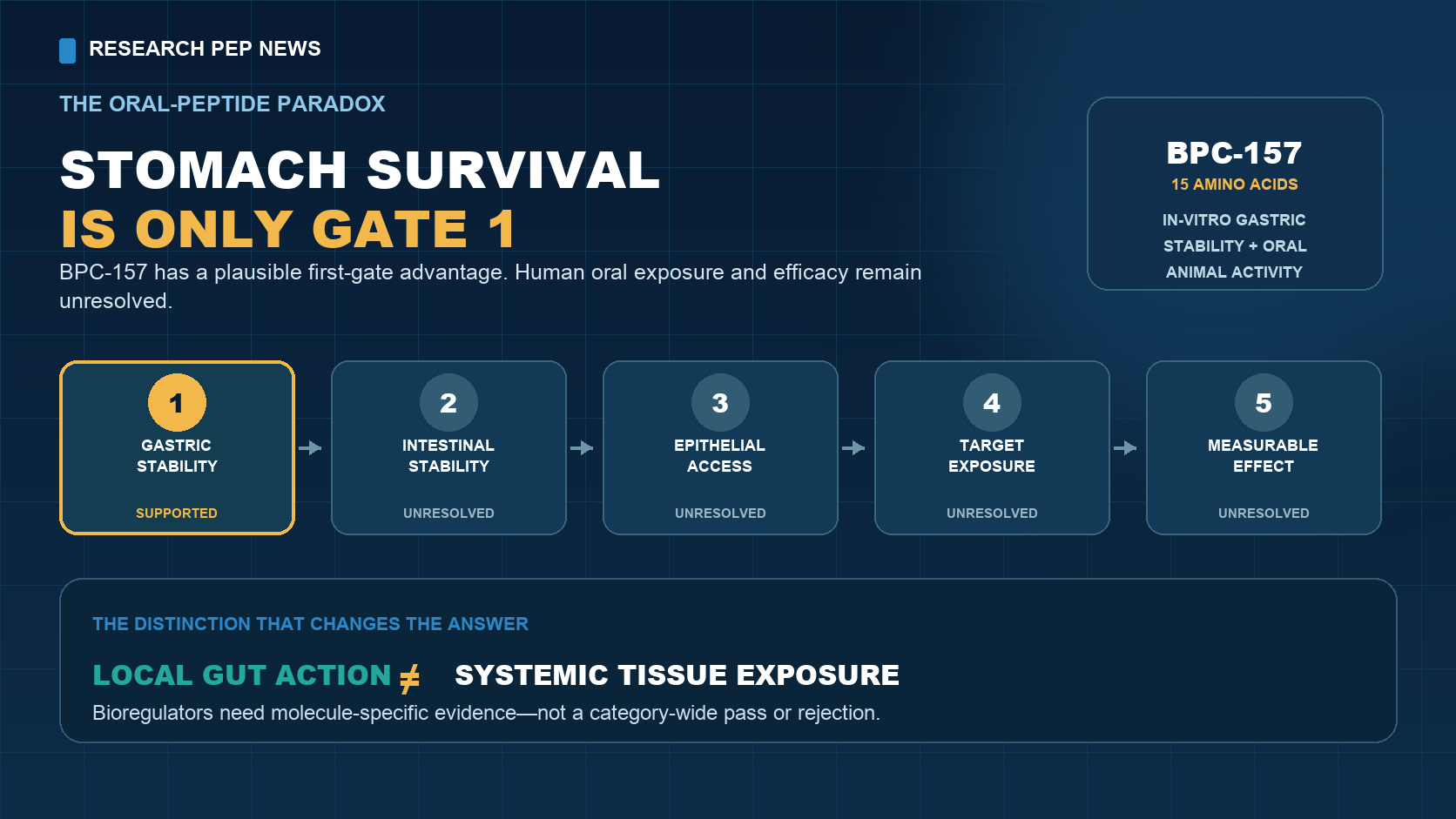
Oral delivery is a five-gate problem
When people ask whether a peptide “survives the stomach,” they are asking only the first question in a longer chain.
| Gate | What must be shown | What a positive result does not prove |
|---|---|---|
| 1. Gastric stability | The molecule remains sufficiently intact in acid and gastric enzymes | Survival in the small intestine or absorption into blood |
| 2. Intestinal stability | It resists pancreatic and brush-border peptidases long enough to act or cross | Passage through the intestinal wall |
| 3. Epithelial access | It crosses the epithelium, uses a transporter or reaches a local luminal target | Meaningful exposure in a distant tissue |
| 4. Target exposure | Intact peptide or an active metabolite reaches the relevant tissue at an active concentration | A beneficial clinical outcome |
| 5. Measurable effect | A reproducible pharmacodynamic or clinical endpoint changes | Safety, durability or benefit for every proposed use |
A locally acting gut peptide may not need substantial blood exposure. A peptide claimed to repair a shoulder tendon, alter a pineal-gland program or regulate gene expression throughout the body does. That local-versus-systemic distinction resolves much of the oral-peptide paradox.
BPC-157 has an unusual first-gate advantage
BPC-157 is a synthetic 15-amino-acid peptide derived from a sequence associated with human gastric juice. Its literature repeatedly describes it as stable in gastric juice. FDA’s 2026 review likewise noted reported resistance to hydrolysis in gastric juice in vitro.
That is a meaningful property. It separates BPC-157 from the simplistic idea that every unprotected peptide is immediately reduced to amino acids in the stomach.
Oral activity has also appeared in animal experiments. BPC-157 delivered in drinking water improved healing measures in rat models involving gastrocutaneous fistulas, colonic injury and myotendinous damage.
Those experiments show that oral administration can produce a biological signal in rodents. They do not reveal whether intact BPC-157 entered the circulation, whether a local gastrointestinal mechanism triggered a downstream response, whether an active fragment mattered or whether the result translates to people.
The replication pattern deserves attention as well. Much of the positive BPC-157 animal literature comes from a connected Croatian research network. A coherent program can reveal a real biological effect, but independent replication is what shows that the effect travels across laboratories, methods and investigators.
This leaves BPC-157 in a promising but very specific position: stronger oral plausibility than the average peptide, without the human exposure data needed to turn plausibility into a route-specific medical conclusion.
Gastric stability is not human bioavailability
The strongest current boundary comes from FDA’s July 2026 BPC-157 briefing.
Reviewers found pharmacokinetic studies after intravenous and intramuscular administration in rats and dogs. Those experiments showed a short circulating half-life after intravenous dosing and dose-related plasma exposure after intramuscular dosing. FDA did not identify human pharmacokinetic data after oral, subcutaneous, intranasal or transdermal BPC-157.
The distinction matters. An in-vitro tube of gastric juice can establish chemical resistance under specified conditions. It cannot reproduce gastric emptying, intestinal peptidases, mucus, epithelial transport, hepatic extraction, food effects, formulation performance or the concentration required at a human target.
Even “detected in plasma” would be only a waypoint. A proper oral pharmacokinetic study should identify intact BPC-157 with a validated analytical method, distinguish it from fragments, report absolute exposure and variability, and connect exposure to a pharmacodynamic endpoint.
For BPC-157, those human data do not yet exist in the public record.
The local-gut hypothesis is stronger than the whole-body capsule claim
Huberman’s description is most defensible when kept local. BPC-157 is linked to gastric biology, remains stable under gastric conditions in vitro and has oral animal data involving gastrointestinal injury. That creates a coherent translational chain:
gastric origin and stability → oral animal gut activity → recurring human interest in gut effects → a testable local gastrointestinal therapy hypothesis.
It does not automatically support oral claims for tendon healing, ligament repair, brain effects or systemic inflammation. Those uses require evidence that enough intact or active material crosses the intestinal barrier and reaches distant tissues.
Recent BPC-157 community discussions reflect the same split. Some people say oral products seemed more useful for gastrointestinal symptoms than injected products. Others report no effect, prefer injection for musculoskeletal goals or say they could not tolerate the oral form. These reports are self-selected, product identity is often uncertain and outcomes are not standardized. They cannot estimate an efficacy rate. They do identify the exact question a trial should test: does verified oral BPC-157 act locally in the human gut, and is that effect separable from systemic exposure?
“Peptide bioregulator” is a theory, not a delivery system
Peptide bioregulators are commonly described as short peptides—often two to seven amino acids—associated with tissue-specific signaling. Some products use defined synthetic sequences; others trace their identity to peptide fractions or organ extracts. Those are not interchangeable materials.
The scientific program associated with Vladimir Khavinson proposes that short peptides can enter cells, interact with DNA or chromatin and influence gene expression. The mechanism is provocative, and the short length of these peptides could offer delivery advantages. A dipeptide or tripeptide may use transport pathways that are inaccessible to a larger peptide.
But “short” is not a substitute for pharmacokinetics.
The most visible reviews of the bioregulator concept are authored by investigators from the institutions that originated the program. They assemble mechanistic, animal and clinical claims, but they do not establish independent, sequence-specific oral exposure for every commercial bioregulator at its marketed dose. A branded category cannot inherit proof from its strongest member.
Epitalon illustrates the gap. It is a defined tetrapeptide tied to pineal-gland and aging claims. In its 2026 review, FDA found no pharmacokinetic data for epitalon free base or acetate and no adequate clinical-outcome evidence for the proposed insomnia use. That does not prove the molecule is inert. It means the route-to-target chain remains unmeasured.
Seeds’ categorical language is therefore stronger than the available evidence can support: missing replication is not proof that no bioregulator can work. His underlying criticism is sound, however. Commercial claims often jump from short sequence to oral absorption to organ targeting to clinical benefit without measuring the steps between them.
The exceptions show what real oral-peptide development looks like
Several peptides demonstrate that oral delivery is possible. They also show why successful oral products are engineered and measured rather than assumed.
Oral semaglutide: a carrier, strict administration and low exposure
Semaglutide is a 31-amino-acid peptide. The approved oral formulation pairs it with SNAC, an absorption enhancer that helps protect the molecule and enables absorption across the stomach lining. Even with that formulation, the FDA label reports absolute bioavailability of roughly 0.4% to 1%, depending on the tablet and conditions.
The drug succeeds because low exposure is sufficient, the dose and formulation are standardized, the pharmacokinetics are measured, and clinical outcomes were demonstrated. It is not evidence that an ordinary peptide capsule works. It is evidence that formulation can convert a difficult molecule into a viable product.
Oral octreotide: protected release plus a permeability enhancer
The approved oral octreotide product uses an enteric-coated capsule and a transient permeability enhancer. Its label describes a reversible increase in intestinal permeability. Again, the delivery technology is part of the medicine.
KPV: a very short peptide with a transporter hypothesis
KPV is a tripeptide. In human intestinal cell models, it can be transported through PepT1, a transporter that normally handles di- and tripeptides. Oral KPV has reduced inflammation in mouse colitis models.
That is a more specific oral-delivery hypothesis than “small peptides absorb.” It identifies a molecule, a transporter, a tissue and an outcome. Human exposure and efficacy data are still missing, and formulation may be decisive: a 2026 prodrug study substantially increased colon exposure compared with free KPV in mice.
Larazotide: local action can be enough
Larazotide is an oral peptide developed to act at the intestinal barrier rather than circulate broadly. Human celiac-disease trials have produced mixed primary-endpoint results, but the program demonstrates an important design principle: systemic bioavailability is not always the goal. A peptide can be pharmacologically useful if it reaches a local target at an effective concentration.
| Peptide or product | Oral rationale | Human oral exposure | Human clinical evidence | What it teaches |
|---|---|---|---|---|
| BPC-157 | Gastric stability; oral animal activity | Not established | No adequate oral trial | Plausible local-gut candidate; systemic claims remain open |
| KPV | Three amino acids; PepT1 transport in cell models | Not established | Not established | Sequence and transporter matter; formulation can change colon exposure |
| Epitalon / bioregulators | Very short sequences; proposed cell and gene-regulatory effects | Not established for epitalon | Proposed uses not established by adequate outcome trials | Category theory cannot replace molecule-specific PK and replication |
| Oral semaglutide | SNAC-enabled gastric absorption | Measured; about 0.4%–1% absolute bioavailability | Established for approved metabolic indications | Low exposure can work when formulation, dose and outcomes are validated |
| Oral octreotide | Enteric protection plus permeability enhancer | Measured | Established for approved acromegaly maintenance use | Delivery technology is part of the active product |
A better standard than belief or disbelief
The peptide field does not benefit from two equally weak shortcuts: dismissing oral delivery because “peptides are digested,” or accepting it because a molecule is marketed as stable, natural, short or tissue-specific.
For any oral peptide, ask five questions:
- What exact molecule is in the capsule? The sequence, salt form, purity, degradation products and finished-product assay should be defined.
- Where is it expected to act? A local gastrointestinal target requires a different evidence package than a brain, tendon or endocrine target.
- What happens in realistic gastrointestinal conditions? Acid stability alone is insufficient; intestinal enzymes, food, transit and formulation matter.
- Has intact exposure been measured? Use validated mass spectrometry or another sequence-specific method in plasma, lumen or target tissue.
- Does exposure predict a reproducible outcome? Pharmacokinetics should connect to a biomarker or clinical endpoint, not end at detectability.
This standard is peptide-positive because it makes the most interesting claims testable. It can discover true oral exceptions instead of burying them inside a category-wide argument.
The study that could resolve the BPC-157 question
The first decisive human study does not need to begin with a whole-body healing claim. It should begin where the evidence is strongest: the gastrointestinal tract.
Research Pep News’ working hypothesis is that BPC-157 is most likely to show a reproducible oral effect first as a locally acting gastrointestinal peptide. Gastric stability, oral animal gut activity and the recurring community pattern all point in that direction. The magnitude, formulation, exposure and safety of that response must be measured in people.
Researchers could randomize adults with a clearly defined inflammatory or mucosal condition to a chemically verified oral BPC-157 formulation or placebo. The study should measure:
- intact BPC-157 and major fragments in gastric or intestinal fluid, plasma and—where ethical—mucosal biopsies;
- product identity, potency and stability throughout the trial;
- local pharmacodynamic markers such as fecal calprotectin, endoscopic healing or validated barrier measures;
- symptoms and quality of life;
- systemic exposure, immune reactions and adverse events; and
- whether outcomes track local concentration, circulating concentration or neither.
That design would separate three possibilities: a genuinely local gut effect, a systemically absorbed effect or no reproducible clinical effect. Each result would advance the field.
Bioregulators deserve the same discipline. Test one defined sequence at a time. Measure oral exposure. Verify the proposed tissue or gene-regulatory effect. Replicate the result outside the originating network. The question is not whether the category sounds plausible. It is whether a specific molecule completes the chain.
Bottom line
The oral-peptide paradox disappears once “survival” and “effect” are separated.
BPC-157 has a credible reason to survive gastric conditions and a real oral signal in animal models. Those findings make it an unusually strong research candidate for local gastrointestinal action. They do not prove human oral bioavailability, distant-tissue delivery or clinical efficacy.
Peptide bioregulators should not be rejected merely because they are peptides, and they should not be accepted merely because they are short. Their most ambitious claims require the same measurements as any other drug: identity, stability, exposure, target engagement, replication and outcome.
The future of oral peptides will be built by exceptions. The way to find them is not through blanket promotion or blanket skepticism. It is to make every capsule pass all five gates.
Source record
- Huberman Lab: Dr. Craig Koniver on peptide and hormone therapies
- Mind Pump 2667 with Dr. William Seeds
- FDA July 2026 BPC-157 briefing document
- FDA July 2026 Pharmacy Compounding Advisory Committee meeting record
- BPC-157 in an oral rat gastrocutaneous-fistula model
- Oral BPC-157 in a rat myotendinous-junction model
- BPC-157 pharmacokinetics in rats and dogs
- KPV transport through PepT1 and oral activity in mouse colitis
- Oral KPV prodrug and colon-exposure study
- Larazotide randomized celiac-disease trial
- Rybelsus prescribing information
- Mycapssa prescribing information
- Peptide-bioregulator review from the originating research network
- FDA July 2026 epitalon briefing document
Research Pep News provides news and educational information, not individualized medical advice. BPC-157, KPV and epitalon are not FDA-approved treatments. Products labeled for research use are not approved for human use. This article evaluates evidence and does not provide dosing or sourcing guidance.
This staff report was prepared for Research Pep News and is presented as news and educational information, not medical advice.