A 28-second Peptide Corner Reel distilled the retatrutide phenomenon into one unforgettable line: people are calling it “the greatest drug that’s ever existed.” The post had drawn about 2,100 reactions, 283 comments and 174 shares when Research Pep News reviewed it.
The language is deliberately viral. The excitement is not invented.
Andrew Huberman has helped bring that expectation into the mainstream. He told Gwyneth Paltrow on The goop Podcast, “The big thing that’s coming out soon is retatrutide.” His explanation captured the design advantage in plain language: the molecule “hits three different pathways, each a bit more subtly.” In a later Huberman Lab discussion, physician Abud Bakri argued that the result could be much greater fat loss with fewer side effects than a more GLP-1-dominant drug.
That is more than celebrity enthusiasm. It is the central scientific proposition behind retatrutide: distribute the metabolic work across GIP, GLP-1 and glucagon signaling instead of asking one pathway to do everything.
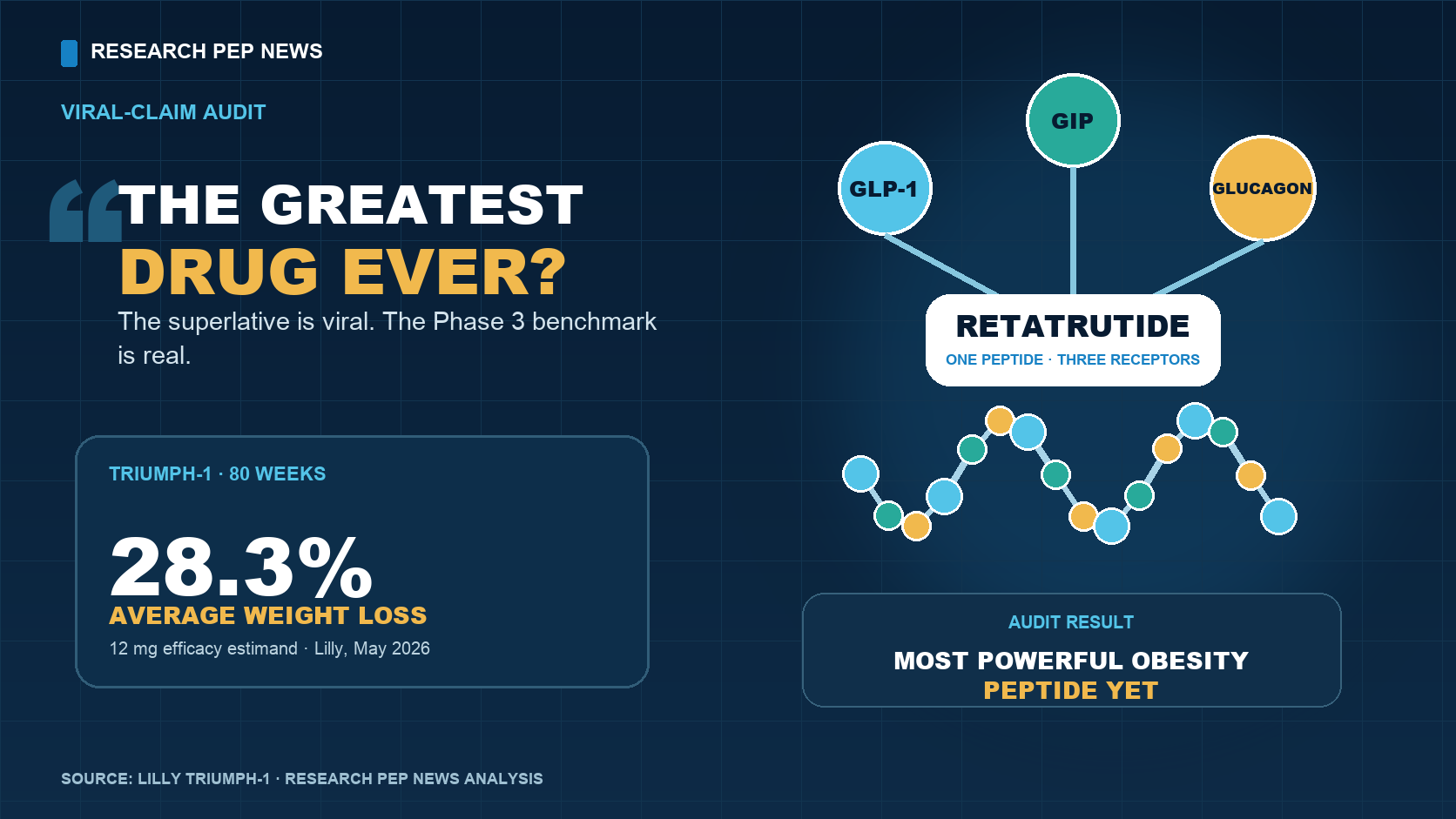
Retatrutide is the first single molecule in late-stage development to activate GIP, GLP-1 and glucagon receptors. In Lilly’s pivotal TRIUMPH-1 obesity trial, the highest-dose group lost an average of 28.3% of body weight at 80 weeks. Among participants with a starting BMI of at least 35 who continued into a prespecified extension, average weight loss reached 30.3% at 104 weeks. Nearly half of participants at the highest dose lost at least 30% by week 80.
Those are not influencer projections. They are Phase 3 results.
The direct answer: “Greatest drug ever” is too broad to function as a scientific verdict. “Most powerful obesity peptide yet” is defensible. Retatrutide has produced the largest mean weight reductions reported for a medication in a pivotal obesity trial, while also improving waist circumference, liver fat, triglycerides, blood pressure, inflammation markers, glucose control and obesity-related complications. Huberman’s lower-GLP-1-burden thesis is biologically credible, and the efficacy-to-tolerability pattern is already encouraging. The precise size of that advantage—and the exact number of people already using retatrutide outside trials—cannot yet be counted from a controlled comparison or public registry. That does not make either signal imaginary.
Why the claim went viral before the drug reached the market
The Peptide Corner caption makes four ideas feel inseparable: three-pathway signaling, extraordinary fat loss, muscle preservation and inevitable commercial dominance. Huberman’s explanation supplied the mechanism behind the superlative. Together, those ideas explain why retatrutide has moved beyond medical meetings and into mainstream podcasts, fitness culture and research-peptide communities.
Joe Rogan encountered the same talking points during a May 2026 episode with musician Marcus King. While looking the drug up in real time, Rogan summarized the pitch this way: “This one is supposed to be better … and it’s supposed to be more effective.”
The public commentary shows that retatrutide’s mechanism and trial results have crossed into culture. The molecule is no longer being discussed only by obesity researchers; it is being framed by some of the world’s largest health and entertainment voices as the next step after semaglutide and tirzepatide.
That framing has a solid scientific center. Retatrutide is not merely a renamed GLP-1 drug. It is a deliberately engineered triple agonist with a human trial record that now spans five positive Phase 3 studies disclosed by Lilly.
Claim 1: “It works across three hormone pathways at once”
Verdict: Supported.
Retatrutide is one peptide engineered to activate three receptors:
- GLP-1, which supports glucose-dependent insulin secretion and helps reduce appetite and food intake;
- GIP, which contributes to insulin signaling and energy balance; and
- glucagon, which participates in hepatic energy metabolism, fat oxidation and energy expenditure.
Structural research has visualized retatrutide bound to all three receptors. The mechanism is therefore more than a marketing diagram. The important question is what that combined signaling produces in people.
The answer is a two-sided metabolic effect: reduced energy intake plus a glucagon-linked pathway that may help move energy use and fat metabolism. The exact contribution of each receptor cannot be read directly from a weight-loss graph, but the triple design supplies a coherent reason retatrutide could push beyond the ceiling reached by single- and dual-receptor drugs.
Claim 2: “The greatest drug ever”
Verdict: Viral rhetoric—with a defensible core.
No single endpoint can name the greatest drug in history. Antibiotics, vaccines, insulin, anesthetics and many other medicines transformed survival in ways that cannot be ranked against a weight-loss percentage.
Inside obesity pharmacotherapy, however, retatrutide has set a new efficacy benchmark.
In TRIUMPH-1, 2,339 adults with obesity or overweight and at least one weight-related condition were randomized to retatrutide or placebo. At 80 weeks, average weight loss reached:
| Group | Average body-weight change |
|---|---|
| Retatrutide 4 mg | −19.0% |
| Retatrutide 9 mg | −25.9% |
| Retatrutide 12 mg | −28.3% |
| Placebo | −2.2% |
At the 12 mg dose, 45.3% of participants lost at least 30% of their starting weight and 27.2% lost at least 35%. Among the higher-BMI participants who entered the 104-week extension and tolerated treatment, average loss reached 30.3% at the highest dose.
For context—not a head-to-head comparison—the landmark STEP 1 semaglutide trial reported 14.9% mean weight loss at 68 weeks, and SURMOUNT-1 reported 20.9% with the highest tirzepatide dose at 72 weeks. Different trials enroll different populations and use different timeframes, but the size of the retatrutide result is unmistakable.
Research Pep News’ audit verdict is that retatrutide is the most powerful obesity medication candidate measured in a pivotal trial to date. That is narrower than “greatest drug ever,” and far more meaningful than dismissing the phrase as empty hype.
What losing 28% to 30% of body weight can mean for health
Retatrutide’s strongest argument is not simply 28.3%. At this scale, weight loss stops being a cosmetic endpoint and becomes a multi-organ metabolic intervention.
In TRIUMPH-1, the highest dose translated to an average loss of 70.3 pounds from a 248.5-pound baseline. Average waist circumference fell by 24.1 centimeters, or 9.5 inches. That reduction matters because abdominal and visceral fat are tightly connected to insulin resistance, fatty-liver disease, high blood pressure and an atherogenic lipid profile. The trial recorded improvements in triglycerides, non-HDL cholesterol, systolic blood pressure and high-sensitivity C-reactive protein. Nearly two-thirds of participants at the highest dose finished below the BMI threshold for obesity.
The liver data show how quickly a scale change can become an organ-level health change. In a randomized retatrutide substudy of participants with metabolic dysfunction-associated steatotic liver disease, the 12 mg group had an 82.4% relative reduction in liver fat at 24 weeks, and 86% reached a normal liver-fat level. Retatrutide also improved insulin-sensitivity markers and reduced triglycerides by more than 40% at the two highest doses by week 48. Glucagon-receptor activity may add a direct liver-fat effect through fatty-acid oxidation in addition to the benefit created by weight loss itself.
There is also a useful historical benchmark. Sustained weight loss in the 25% to 30% range has previously been achievable mainly through metabolic surgery. Long-term surgical studies associate weight loss in that range with durable remission or prevention of type 2 diabetes, hypertension and dyslipidemia, along with lower cardiovascular and all-cause mortality. Retatrutide is the first drug candidate to bring average weight loss into that neighborhood in a pivotal obesity trial. The medical opportunity is not merely a smaller body. It is the possibility of changing the trajectory of several chronic diseases at once without an operation.
Other Phase 3 trials broadened the signal:
- In adults with obesity and knee osteoarthritis, retatrutide reduced body weight by up to 28.7% and sharply improved knee-pain scores.
- In adults with recent-onset type 2 diabetes, it lowered A1C by as much as 2.0 percentage points and body weight by 16.8% over 40 weeks.
- In adults with obesity and type 2 diabetes, TRIUMPH-2 reported up to 20.8% weight loss at 80 weeks alongside improved glucose control.
- In adults with severe obesity and established cardiovascular disease, TRIUMPH-3 reported up to 22.6% weight loss and favorable changes in triglycerides, non-HDL cholesterol, blood pressure, waist circumference and inflammation.
That is why the drug feels bigger than a cosmetic weight-loss story. Less visceral and liver fat can improve insulin sensitivity. Lower blood pressure and a healthier lipid profile reduce major cardiovascular risk pathways. A lighter mechanical load can make movement easier and reduce stress on painful joints, creating a positive loop in which activity becomes more possible. Better glucose control can reduce the medication burden of type 2 diabetes. Retatrutide is being developed as a platform treatment for obesity and several of the diseases that travel with it.
Claim 3: “Fat burning and muscle preservation from a single drug”
Verdict: Fat-loss dominant, not muscle-loss free.
This is the most important refinement to the Peptide Corner caption.
A DXA substudy in adults with type 2 diabetes found that retatrutide reduced total fat mass by up to 26.1% at 36 weeks. The proportion of lean mass lost relative to total weight loss was similar to other obesity treatments; it was not disproportionately high despite retatrutide’s larger overall effect.
That supports a positive conclusion: the additional weight loss was not created by an unusually large sacrifice of lean tissue. It does not support saying retatrutide automatically preserves all muscle.
Peter Attia has summarized the practical GLP-1 experience more usefully: “When patients are counseled thoroughly” on protein and resistance training, “we’re seeing very little lean mass lost.” His point is not that the medication does every job. It is that body composition can be actively managed while the peptide drives large fat loss.
The best current statement is therefore stronger and more accurate than either extreme: retatrutide produces predominantly fat-mass reduction, without evidence of disproportionate lean-mass loss, while resistance training and adequate protein remain the controllable variables for protecting muscle.
Claim 4: “It has fewer side effects”
Verdict: Mechanistically credible, with a strong efficacy-to-tolerability signal.
Huberman described retatrutide as a milder GLP-1 agonist, and physician Abud Bakri told him the drug appeared much more effective for fat loss with fewer side effects. That interpretation fits the molecule’s design.
Retatrutide is not simply “more GLP-1.” Laboratory receptor assays found that it was 2.5 times less potent at the human GLP-1 receptor than native GLP-1, while being 8.9 times more potent at the human GIP receptor than native GIP and 2.9 times less potent at the glucagon receptor than native glucagon. Semaglutide concentrates its action on GLP-1 receptors. Retatrutide spreads the work across three pathways, creating a credible route to greater metabolic output without requiring the same degree of GLP-1 dominance. Because nausea, vomiting and slowed gastric emptying are closely associated with GLP-1 signaling, the receptor balance gives the lower-side-effect claim a rational biological foundation.
The clinical pattern is encouraging. In TRIUMPH-1, the 12 mg group achieved 28.3% average weight loss while nausea occurred in 42.4%, diarrhea in 32.0%, constipation in 26.1% and vomiting in 25.3%. Those raw gastrointestinal rates are broadly similar to the semaglutide STEP 1 profile even though retatrutide produced far more average weight loss across the separate trials. That makes retatrutide’s efficacy per unit of gastrointestinal burden look favorable, while recognizing that cross-trial percentages are not a randomized head-to-head comparison. At the maximum dose, dysesthesia occurred in 12.5% and 11.3% discontinued because of adverse events, so the advantage should not be mistaken for a symptom-free drug.
The 4 mg result makes the case more strongly: 19.0% average weight loss with nausea in 28.6%, vomiting in 10.6% and an adverse-event discontinuation rate of 4.1%, compared with 4.9% for placebo. Retatrutide therefore appears able to deliver semaglutide-beating average weight loss at a lower-dose level with a substantially lighter gastrointestinal profile than its own maximum dose.
Research Pep News’ working conclusion is that retatrutide’s lower GLP-1 emphasis and added GIP/glucagon activity produce a real tolerability advantage relative to the amount of weight lost. A direct semaglutide comparison would put a more exact number on that advantage; its absence is not evidence that the mechanism, trial pattern or recurring field reports are wrong.
Claim 5: “It will be the first trillion-dollar drug”
Verdict: A scale metaphor, not an audited forecast.
“Trillion-dollar drug” can mean annual sales, cumulative sales, the value created across a company or a broader effect on healthcare spending. Those are radically different claims. The Peptide Corner Reel does not define the metric, and Lilly has not published a forecast establishing a trillion-dollar value for retatrutide.
The commercial premise is still easy to understand. A therapy capable of moving obesity, diabetes, sleep apnea, osteoarthritis pain and cardiometabolic risk factors could reach an enormous population and reduce costs across multiple disease categories. Retatrutide may become one of the most commercially consequential medicines ever launched.
That is the claim worth tracking. “Trillion-dollar” is the viral compression of it, not a financial result.
Claim 6: “Approval is a formality”
Verdict: The program is unusually strong; the date is not automatic.
The regulatory outlook has advanced since the Peptide Corner Reel was posted. Lilly now says five Phase 3 retatrutide studies have produced positive results and that the clinical package supports global submissions. On July 23, 2026, the company said it plans to file a U.S. Biologics License Application in the first quarter of 2027.
That makes retatrutide a late-stage candidate with a defined submission plan—not an uncertain laboratory concept. FDA review will still evaluate the full efficacy, safety, manufacturing and labeling package. Approval is a high-confidence possibility, not paperwork already completed.
Claim 7: “Millions are already using it”
Verdict: A large real-world signal; the exact headcount is unaudited.
Retatrutide discussion and use outside Lilly’s trials are plainly widespread across peptide communities, telehealth conversations and social media. Repeated reports of weight loss, changed appetite, different energy levels and a distinct side-effect experience are data: specifically, self-selected observational data. They are less controlled than a randomized placebo trial, and the identity and quality of products may vary, yet that does not make the collective field signal meaningless.
No public registry counts every person using retatrutide outside a Lilly trial, so Research Pep News cannot independently audit the word “millions.” The absence of a registry is not evidence that the estimate is false. It means the scale should be described as a credible market observation rather than a measured prevalence figure.
That distinction should not become a reason to stigmatize the research market. The molecule published in Lilly’s patents and studied in its trials has created demand because the biological signal is exceptional. The responsible dividing line is verification: identity, purity, quantity, sterility, endotoxin control, storage and traceable batch testing.
Research Pep News does not assume that every research-labeled vial is poor quality, just as a pharmacy label alone does not make every compounded product equivalent to the drug used in a clinical trial. Claims about retatrutide’s clinical performance come from verified trial material. Claims about any other product require product-specific evidence. The evidence supports verification, not stigma.
The viral claim gets the direction right
The Peptide Corner Reel is strongest where it follows the biology and weakest where it turns momentum into certainty.
| Viral claim | Audit verdict |
|---|---|
| Three pathways in one molecule | Supported |
| Unprecedented medication-driven weight loss | Supported |
| Major fat-mass reduction without disproportionate lean-mass loss | Supported with precision |
| Fewer side effects than semaglutide | Mechanistically credible; favorable efficacy-to-tolerability signal |
| First trillion-dollar drug | Undefined forecast |
| Approval is a formality | Strong program, regulatory decision still ahead |
| Millions already use it | Large field signal; exact count unaudited |
The result of this audit is not a debunking. It is a sharper version of the hype.
Retatrutide combines three established metabolic pathways in one peptide. It has produced the largest mean weight loss yet reported in a pivotal obesity-drug trial. Its body-composition data show that fat loss dominates the change rather than lean tissue being uniquely depleted. Its Phase 3 program has moved beyond weight into glucose control, knee pain, sleep apnea and cardiometabolic risk.
Those facts are remarkable without calling every projection settled.
Bottom line
Is retatrutide the greatest drug ever? That is not a question medicine can answer with one leaderboard.
Is it the most powerful obesity peptide yet tested in a pivotal trial? The available data say yes.
Peptide Corner captured why the market is leaning forward: retatrutide is not an incremental GLP-1 update. It is a triple-agonist platform producing surgery-range average weight loss in some trial populations and improving several conditions tied to obesity at the same time.
The most credible version of the viral claim is already extraordinary: retatrutide may become the defining metabolic medicine of the next phase of peptide therapeutics.
Source record
- Peptide Corner Facebook Reel: “the greatest drug that’s ever existed”
- TRIUMPH-1 Phase 3 obesity results, Eli Lilly
- TRIUMPH-2 and TRIUMPH-3 results and planned Q1 2027 U.S. submission, Eli Lilly
- TRIUMPH-4 Phase 3 obesity and knee-osteoarthritis results, Eli Lilly
- American Diabetes Association summary of TRANSCEND-T2D-1 and TRIUMPH-1
- Phase 2 retatrutide obesity trial, New England Journal of Medicine
- Retatrutide body-composition DXA substudy, The Lancet Diabetes & Endocrinology
- Retatrutide MASLD and liver-fat substudy, Nature Medicine
- Retatrutide discovery and receptor pharmacology, Cell Metabolism
- Structural study of retatrutide at GLP-1, GIP and glucagon receptors
- Semaglutide STEP 1 obesity trial, New England Journal of Medicine
- Tirzepatide SURMOUNT-1 obesity trial, New England Journal of Medicine
- Andrew Huberman interview on The goop Podcast
- Huberman Lab peptide episode with Dr. Abud Bakri
- Joe Rogan Experience #2499 with Marcus King
- Peter Attia AMA #86 on GLP-1 drugs, lean mass and retatrutide
- Twelve-year metabolic outcomes after gastric bypass, New England Journal of Medicine
- Long-term mortality outcomes after bariatric surgery, New England Journal of Medicine
- Lilly’s current retatrutide status page
Research Pep News provides news and educational information, not individualized medical advice. Retatrutide is investigational and is not currently approved by the FDA or another regulatory agency. This article does not provide a dosing protocol or recommend personal use.
This staff report was prepared for Research Pep News and is presented as news and educational information, not medical advice.