A short Peptide Corner Facebook Reel turns a complicated fertility question into a striking before-and-after story. A young man with obesity, insulin resistance and a low sperm count reportedly lost 100 pounds while using tirzepatide, exercising and improving his diet. His sperm count rose roughly tenfold and entered the normal range.
The source is urologist Alex Tatem, speaking at about 22 minutes into The Diary of a CEO interview. Tatem said the patient had “increased his sperm count 10 times over” after the combined metabolic intervention.
The multiplier is memorable. The larger question reaches far beyond tirzepatide: can GLP-1-based drugs improve male fertility when obesity and insulin resistance are part of the cause?
Human studies now give that question a class-wide foundation. Diet-induced weight loss has raised sperm concentration and total count. Liraglutide has helped maintain that improvement alongside maintained weight loss. Semaglutide has improved sperm morphology in a small randomized trial. Tirzepatide has produced a strong testosterone signal in men with metabolic hypogonadism. Retatrutide has not reported a male-fertility outcome, but its unusually large weight-loss effect makes it the next obvious hypothesis.
The direct answer: GLP-1-assisted metabolic recovery can improve testosterone and selected semen parameters in men whose reproductive function is being suppressed by obesity, insulin resistance or functional hypogonadism. The direction is now supported across weight-loss, liraglutide, semaglutide and tirzepatide evidence. The magnitude is not yet predictable, every sperm measure does not move together, and no study has shown that retatrutide improves fertility. The most interesting proposition is that the depth and durability of metabolic recovery may matter more than the brand name on the prescription.
The case contains four interventions—and one class-wide question
The viral version makes tirzepatide the protagonist. Tatem’s full sentence names four changes:
- tirzepatide treatment;
- a 100-pound weight loss;
- regular exercise; and
- an improved diet.
That combination does not weaken the story. It defines it.
For a man whose low sperm production is being driven by severe obesity and metabolic hypogonadism, the relevant treatment target is the metabolic environment around the testes and the brain signals that regulate them. Tirzepatide may be the tool that makes large, sustained weight loss possible. Exercise, nutrition, sleep and the reduction in visceral fat can each change the same hormonal and inflammatory system.
The case therefore supports a metabolic-recovery hypothesis, not a claim that tirzepatide directly multiplied sperm cells tenfold. Once that distinction is clear, liraglutide, semaglutide, tirzepatide and retatrutide belong in the same research conversation—even though the evidence for each is at a different stage.
How obesity can suppress the male reproductive axis
Male fertility depends on a signaling loop called the hypothalamic-pituitary-gonadal axis. The brain releases gonadotropin-releasing hormone. The pituitary responds with luteinizing hormone and follicle-stimulating hormone. Those signals tell the testes to produce testosterone and support spermatogenesis.
Excess adipose tissue can press on that system from several directions. Greater aromatase activity converts more testosterone into estradiol. Insulin resistance, inflammation and altered leptin signaling can reduce hypothalamic and pituitary output. Lower sex hormone-binding globulin can lower measured total testosterone. Obesity is also associated with greater scrotal heat, sleep apnea, diabetes and oxidative stress—all relevant to testicular function and semen quality.
A 2025 review in The Journal of Clinical Endocrinology & Metabolism summarized the human and preclinical bridge: obesity is associated with lower luteinizing hormone, testosterone, semen volume and sperm count, while GLP-1-based treatment may improve reproduction indirectly through weight loss and possibly through direct signaling in the hypothalamus or testes.
The direct pathway remains an open question. An eight-hour randomized infusion study in 18 healthy, lean men did not change average luteinizing hormone, follicle-stimulating hormone or testosterone. That finding points toward metabolic repair, treatment duration or disease context as the conditions that make the reproductive signal visible.
Liraglutide reveals the metabolic foundation
The strongest experiment for interpreting the 100-pound story did not begin with tirzepatide. It began with diet-induced weight loss and then tested whether exercise or liraglutide could help preserve the result.
In the S-LiTE randomized trial substudy, 47 men with obesity completed an eight-week low-calorie intervention and lost an average of 16.5 kilograms, or about 36 pounds. Sperm concentration increased 1.49-fold and total sperm count increased 1.41-fold.
The benefit lasted one year among the men who maintained substantial weight loss. Men who regained more weight did not preserve the same improvement. Semen volume, sperm motility and total motile sperm count did not significantly change.
The maintenance phase compared exercise, liraglutide, their combination and placebo. Liraglutide helped maintain weight loss without harming semen quality, yet the investigators did not find an additional semen benefit beyond the initial diet-induced improvement. In this study, sustained weight loss—not liraglutide exposure by itself—was the clearest predictor.
That does not make liraglutide irrelevant. It defines the role a GLP-1 drug may play: making a biologically important weight reduction achievable and durable enough for reproductive recovery to persist. A large metabolic change can move sperm concentration and count even when every semen parameter does not improve together.
Tirzepatide’s strongest published signal is hormonal recovery
The most specific published tirzepatide study in men measured metabolic hypogonadism rather than semen.
A 2025 controlled pilot study followed 83 men with obesity and low testosterone for two months. Twenty-eight received tirzepatide alongside a hypocaloric diet and daily walking; comparison groups received lifestyle management alone or transdermal testosterone.
In the tirzepatide group, median body weight fell from 100.5 to 92 kilograms. Median total testosterone rose from 186.5 to 424 ng/dL, a 128.5% increase. Luteinizing hormone and follicle-stimulating hormone increased, while estradiol fell.
Those are the exact hormonal movements expected when obesity-related suppression of the reproductive axis begins to reverse. The study was short, small and not randomized, and it performed no semen analysis. It supports the mechanism behind Tatem’s story without measuring the story’s central sperm outcome. Tirzepatide therefore has a strong male-hormone signal and an exceptional patient report, not a completed fertility trial.
A much larger 2026 American Urological Association abstract adds class-level support. In 1,629 men with paired measurements after semaglutide or tirzepatide treatment, median total testosterone increased from 320 to 419 ng/dL. The retrospective analysis did not separate a tirzepatide-only fertility effect and did not report semen outcomes.
Semaglutide provides direct human semen evidence
Two newer human studies move closer to sperm production and make a tirzepatide-only headline unnecessarily narrow.
A 2025 propensity-matched database study compared men with obesity or overweight who had abnormal semen parameters. Among men exposed to a GLP-1 drug, sperm count later normalized in 10 of 351 cases, compared with 0 of 358 controls. Motility normalization did not differ, and semen-volume normalization favored the controls. The study combined multiple GLP-1 drugs and could not measure the size of each sperm-count change.
A 24-week randomized open-label trial compared semaglutide with testosterone replacement in 25 men with obesity, type 2 diabetes and functional hypogonadism. In the 13-man semaglutide group, morphologically normal sperm increased from a median of 2% to 4%. Semen volume and total motility did not change significantly. Testosterone treatment raised circulating testosterone but reduced sperm concentration and total sperm number.
That last contrast matters. A higher blood testosterone value is not automatically a fertility treatment. Exogenous testosterone can suppress the pituitary signals and intratesticular testosterone required for sperm production.
A 2026 systematic review assembled 10 human studies involving 639 men treated with liraglutide, semaglutide, dulaglutide or exenatide. The most consistent class-wide result was higher total testosterone, especially in men with obesity, type 2 diabetes or functional hypogonadism. Semen improvements appeared in metabolically unhealthy or hypogonadal groups, while healthy men did not show the same signal.
That pattern strengthens the central interpretation: GLP-1 drugs are most likely to help when there is metabolic suppression available to reverse. They are not general-purpose sperm boosters for every man.
Retatrutide is the most interesting untested extension
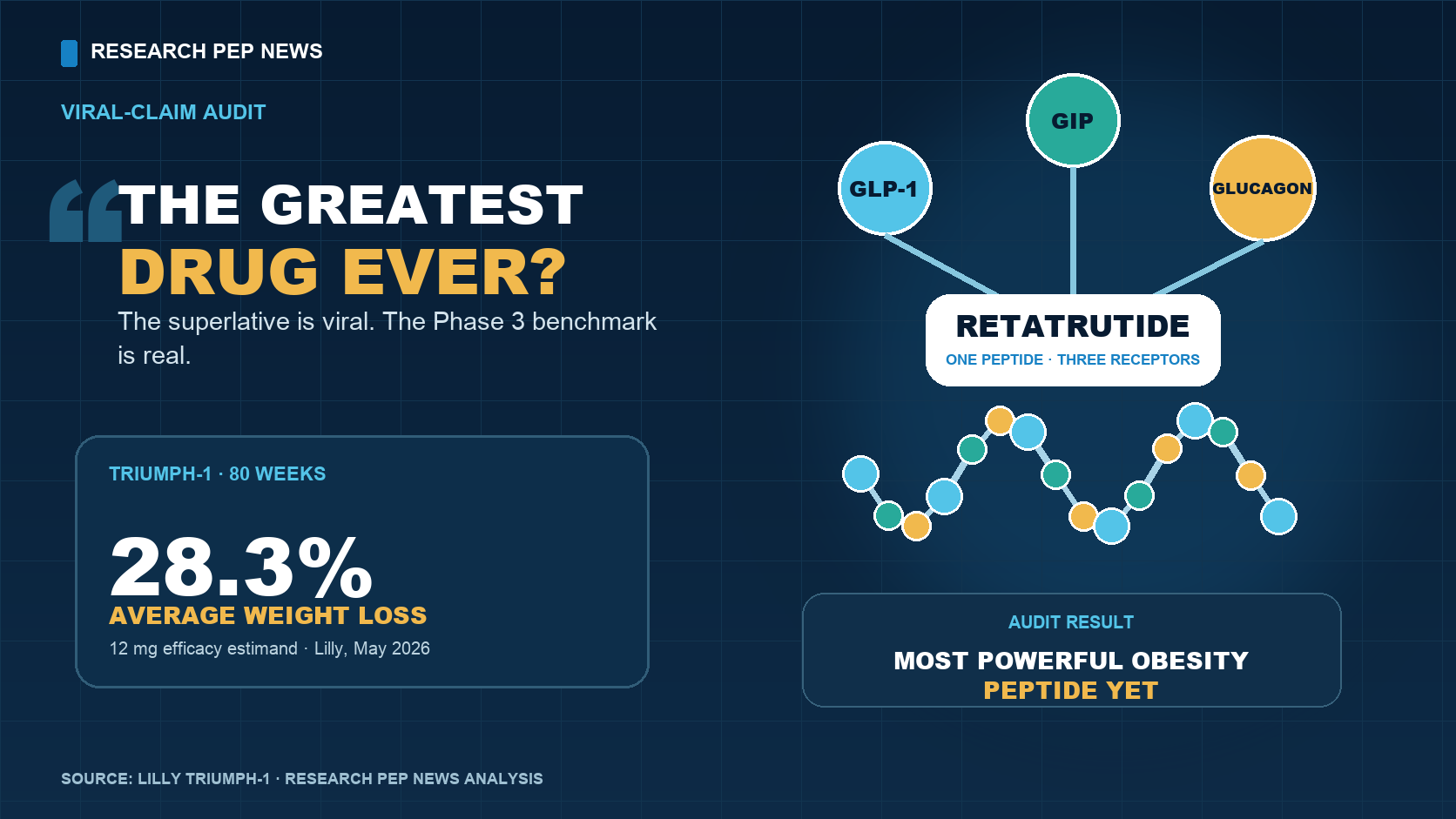
Retatrutide is not a conventional single-receptor GLP-1 drug. It is one molecule that activates GLP-1, GIP and glucagon receptors. Tirzepatide activates GLP-1 and GIP receptors. “GLP-1-based drugs” is therefore the most accurate umbrella term for comparing them with semaglutide and liraglutide.
In the peer-reviewed Phase 2 obesity trial, the highest retatrutide dose produced an average 24.2% weight reduction at 48 weeks. If the reproductive benefit is driven mainly by reductions in visceral fat, insulin resistance, inflammation and obesity-related hormonal suppression, an intervention capable of producing a metabolic change that large should be studied for male reproductive outcomes.
Retatrutide has not yet reported a human semen or male-fertility outcome. That is an untested proposition, not a negative result.
Research Pep News expects retatrutide will produce a reproductive signal in men with obesity-related functional hypogonadism. The testable prediction is that testosterone, LH, FSH and selected semen measures will improve most in the men who achieve the largest sustained reductions in waist circumference, visceral fat and insulin resistance. A matched-weight comparison with tirzepatide or semaglutide would reveal whether retatrutide adds a drug-specific reproductive effect beyond the metabolic change itself.
What the evidence can—and cannot—separate
| Evidence | Human finding | Best interpretation |
|---|---|---|
| Weight loss + liraglutide | 16.5-kg initial loss; concentration 1.49× and count 1.41×; gains persisted with maintained loss | Metabolic recovery is the strongest common pathway |
| Semaglutide trial | Normal morphology rose from 2% to 4% in 13 treated men | Direct randomized semen evidence, with other parameters unchanged |
| Tirzepatide pilot | Weight, waist and estradiol fell; testosterone rose from 186.5 to 424 ng/dL | Strong hormone recovery; semen was not measured |
| GLP-1 class cohort | Count normalized in 10/351 exposed men versus 0/358 controls | An early class-level sperm-count association |
| Tatem patient report | Tirzepatide, 100-pound loss, exercise and diet; sperm count reportedly rose 10× | A plausible high-response case, not a typical drug effect |
| Retatrutide hypothesis | 24.2% average weight loss at 48 weeks; fertility outcomes not measured | A compelling candidate for a direct reproductive trial |
The direction converges: improving metabolic health can restore parts of male reproductive function. The magnitude varies, different sperm measures do not move as one unit, and the evidence does not justify assigning the same effect size to every drug.
Why “tenfold” needs a baseline
A tenfold change can describe very different clinical journeys. An increase from 1 million to 10 million sperm per milliliter is large but remains below the current World Health Organization lower reference limit. An increase from 2 million to 20 million crosses that line. Tatem said his patient moved into the normal range, but the starting and final values, semen volume, motility, morphology, abstinence interval and number of samples were not disclosed.
Semen measurements are also unusually variable. The AUA/ASRM male-infertility guideline recommends considering at least two analyses obtained about a month apart, especially when the first result is abnormal. A single parameter above or below a reference limit does not by itself prove fertility or infertility.
This is the correct boundary for the case: the tenfold change is a physician-reported clinical observation. It is not a response rate, an average effect or a controlled estimate of what tirzepatide contributes.
Exercise and diet are part of the mechanism
Calling exercise and diet “confounders” is statistically correct when the narrow question is whether tirzepatide alone changed sperm count. Clinically, they are active parts of the intervention.
Exercise can improve insulin sensitivity and cardiorespiratory fitness even before major scale changes. Resistance training helps preserve lean mass during rapid weight loss. A more nutrient-dense diet can improve glycemic control and reduce the risk that a large energy deficit creates nutritional gaps. Better sleep and treatment of obstructive sleep apnea can improve the hormonal environment as well.
The Facebook Reel’s strongest line is therefore its least sensational one: the peptide did not directly “fix” fertility; the metabolic system changed. That interpretation agrees with the best human weight-loss experiment available.
Research Pep News’ working hypothesis
Research Pep News’ working hypothesis is that the male reproductive benefit of GLP-1-based drugs will correlate more strongly with the depth and durability of metabolic recovery than with the name of the drug.
We expect liraglutide, semaglutide, tirzepatide and retatrutide to produce the largest responses in men who begin with severe insulin resistance, central adiposity, low or low-normal gonadotropins and low testosterone—precisely the phenotype Tatem described. Sperm concentration, total count and morphology should improve most when endogenous LH, FSH and testosterone recover and the reduction in visceral fat is maintained.
A direct incretin-receptor effect on the hypothalamus, Leydig cells, Sertoli cells or sperm remains biologically plausible. It should appear as a reproductive benefit that exceeds what matched weight loss and metabolic improvement can explain. Because tirzepatide adds GIP signaling and retatrutide adds both GIP and glucagon signaling, those comparisons could reveal whether receptor balance matters independently of weight reduction.
That prediction is already testable.
A registered trial is designed to answer the question
ClinicalTrials.gov record NCT07179120 describes a randomized, assessor-masked study of 180 men aged 20 to 45 with obesity-related infertility. It will compare tirzepatide plus standardized lifestyle management, semaglutide plus the same program and lifestyle management alone.
The primary endpoint is change in sperm concentration at 32 weeks. Secondary outcomes include total sperm count, motility, testosterone, LH, FSH, waist circumference and natural pregnancy through 48 weeks. The record remained not yet recruiting when Research Pep News checked it on August 5, 2026.
The design can answer whether adding a GLP-1-based drug improves outcomes beyond an intensive lifestyle program. A prespecified mediation analysis relating weight change to sperm change would sharpen the next question: is the fertility benefit proportional to the metabolic recovery, or does one drug produce an additional reproductive effect at similar weight loss?
The logical follow-up would add a retatrutide arm after its broader development program establishes an appropriate clinical pathway. Matching participants by achieved weight loss, waist change and insulin-sensitivity improvement would separate the class-wide metabolic effect from any additional contribution of GIP or glucagon-receptor activity.
What men trying to conceive should measure
The viral story is not a reason to treat one laboratory number in isolation. A fertility evaluation should connect reproductive history, at least two semen analyses, testosterone, LH, FSH and the partner’s fertility context. Fever, illness, abstinence interval, varicocele, medications, anabolic steroids, exogenous testosterone, heat exposure and laboratory methods can all change the interpretation.
The exogenous-testosterone issue deserves special emphasis. The AUA/ASRM guideline says testosterone monotherapy should not be prescribed to men interested in current or future fertility because sperm production can fall or stop. A fertility-aware clinician may evaluate other ways of addressing low testosterone while protecting spermatogenesis.
Bottom line
Dr. Alex Tatem’s patient story gets the direction right. Severe obesity and insulin resistance can suppress the male reproductive axis, and a large, sustained metabolic reversal can raise endogenous testosterone and improve selected sperm measures. Tirzepatide may have been an exceptionally effective catalyst for that reversal, but it is no longer the only drug relevant to the question.
Liraglutide helps show that maintaining weight loss can maintain a sperm-count improvement. Semaglutide supplies a randomized human semen signal. Tirzepatide supplies a strong testosterone signal and the case that started this discussion. Retatrutide supplies the most provocative next hypothesis because its metabolic effect is so large.
The tenfold increase cannot be assigned to tirzepatide alone because the patient also lost 100 pounds, exercised and changed his diet. That does not make the result a meaningless anecdote. It makes it a high-response case that points toward a specific population and a class-wide experiment.
The evidence now supports a confident, testable proposition: for men whose infertility is partly metabolic, GLP-1-enabled weight loss can become reproductive treatment by repairing the system that sperm production depends on. The registered semaglutide-versus-tirzepatide trial can test the first drug comparison. Retatrutide should be next.
Source record
- Peptide Corner Facebook Reel: 100-pound weight loss and tenfold sperm-count story
- The Diary of a CEO interview transcript with Dr. Alex Tatem
- Diet-induced weight loss, liraglutide, exercise and sperm count: S-LiTE trial
- Tirzepatide and metabolic hypogonadism controlled pilot study
- Semaglutide versus testosterone trial with semen outcomes
- 2025 GLP-1 exposure and semen-parameter cohort
- 2026 semaglutide/tirzepatide testosterone cohort
- GLP-1 agonists and reproductive function review
- Acute GLP-1 infusion study in healthy men
- 2026 systematic review of GLP-1 drugs, male reproductive hormones and semen outcomes
- Peer-reviewed Phase 2 retatrutide obesity trial
- AUA/ASRM male-infertility guideline, amended 2024
- ClinicalTrials.gov: semaglutide, tirzepatide and lifestyle trial, NCT07179120
- Zepbound prescribing information and nonclinical fertility data
- Pexels source photograph by Karolina Grabowska/Kaboompics
Research status: No GLP-1-based drug is FDA-approved to treat male infertility or low sperm count, and retatrutide remains investigational. Semen parameters are surrogate markers and do not by themselves establish the probability of pregnancy or live birth. This article is educational reporting and does not recommend starting, stopping or changing a prescription without clinical review.
This staff report was prepared for Research Pep News and is presented as news and educational information, not medical advice.