The most interesting GLP-1 stories often begin before the clinical literature is ready for them. People taking semaglutide or tirzepatide for diabetes or weight loss began reporting that alcohol felt less compelling, cigarettes became easier to ignore, or the constant mental pull toward a substance had gone quiet.
That community signal is still visible. A July 2026 r/science discussion of a new oral-semaglutide alcohol trial drew about 580 points and dozens of comments. Some readers described losing interest in alcohol; others described no change or a broader flattening of reward. An Instagram post about GLP-1s and addiction reached the same question from another direction.
Those reports are not controlled evidence. They correctly identified a research target.
Three randomized semaglutide trials now report reductions in alcohol craving, drinks per occasion or heavy-drinking days. A 2026 tirzepatide study shows direct effects on alcohol reward, dopamine signaling and relapse-like behavior in rodents.
This is no longer a fringe idea. It is also not proof that GLP-1 drugs permanently rewire or reset a human brain.
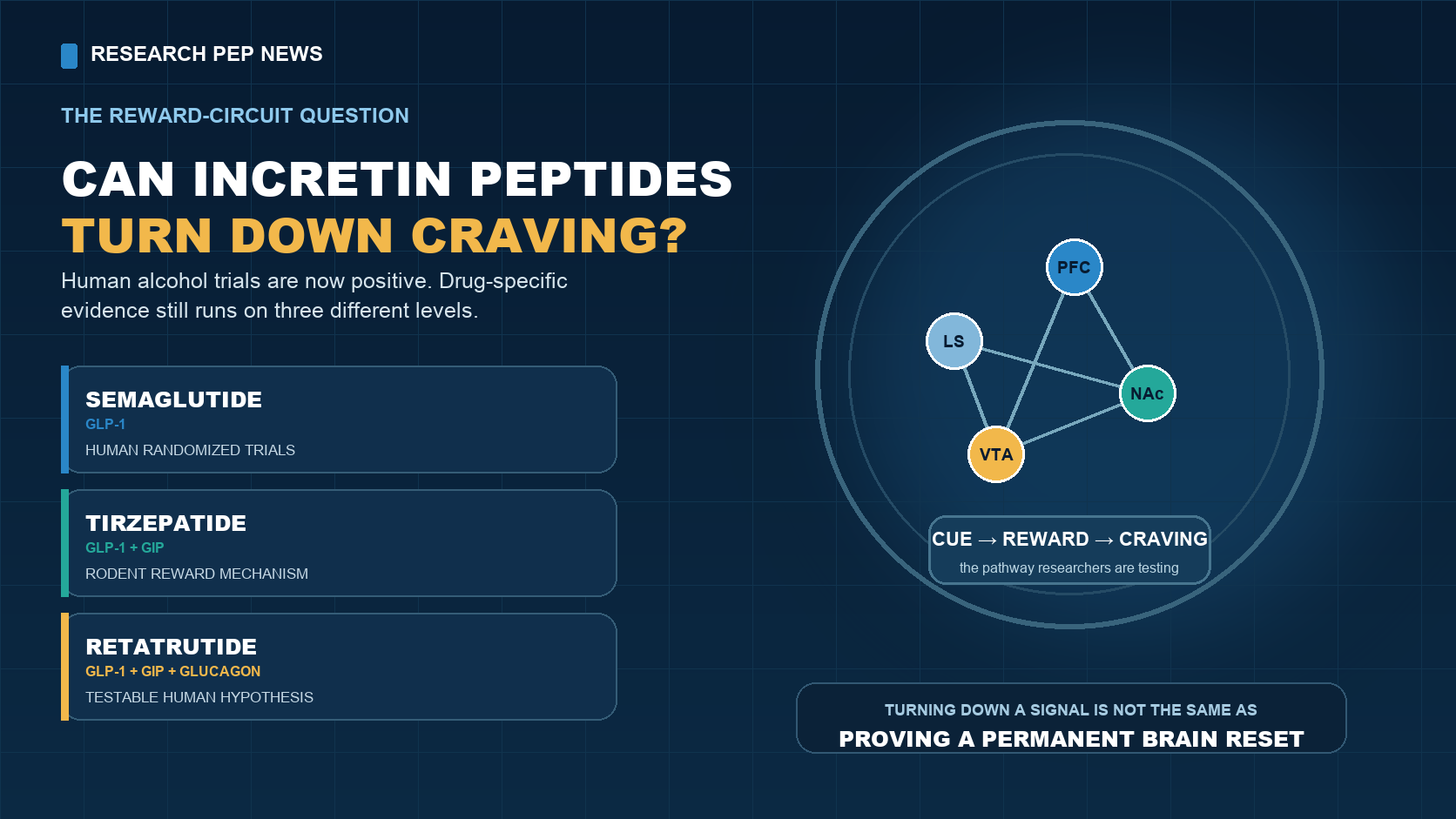
The direct answer: Semaglutide can reduce alcohol craving and harmful drinking outcomes in randomized human trials. Tirzepatide has a strong preclinical alcohol-reward signal and supportive human observational data. Retatrutide has not been tested in an addiction trial. The best-supported model is that incretin signaling can turn down the cue-driven reward value of alcohol and perhaps other substances, creating a wider window for recovery. Whether that change becomes a durable “reset” after treatment ends remains an unanswered—and now testable—question.
“Reset” is ahead of the evidence. The reward biology is real.
Addiction is not a single broken switch in a “reward center.” Repeated alcohol or drug exposure changes learning, stress responses, motivation, memory and the importance the brain assigns to substance-associated cues. Dopamine signaling in circuits connecting the ventral tegmental area, nucleus accumbens, prefrontal cortex and other regions helps make those cues feel urgent and worth pursuing.
GLP-1 is also a brain signal. GLP-1 receptors are present in several of the same circuits. In animal experiments, activating those receptors can reduce the amount of effort an animal will expend for alcohol or cocaine, weaken conditioned reward and reduce reinstatement behavior used to model relapse.
The molecule-specific evidence is unusually direct. In 2023, semaglutide reduced alcohol intake and relapse-like drinking in male and female rats. In male mice, it also attenuated alcohol-triggered dopamine release in the nucleus accumbens shell. In 2026, tirzepatide reduced voluntary, binge-like and relapse-like drinking in rodents, weakened alcohol-conditioned reward and dampened alcohol-triggered accumbal dopamine.
That looks less like erasing a memory and more like lowering its motivational volume. The alcohol cue can still exist. The learned history can still exist. The signal saying “pursue this now” may become easier to resist.
Semaglutide has crossed from anecdotes into three randomized trials
The three trials do not answer exactly the same question. Together, they establish that the alcohol signal can be reproduced under randomized conditions, across injectable and oral semaglutide, in both treatment-seeking and non-treatment-seeking adults.
Trial 1: less alcohol in the lab and lower weekly craving
The first published semaglutide trial randomized 48 adults with alcohol-use disorder who were not seeking treatment. Participants received low-dose weekly semaglutide or placebo for nine weeks.
Semaglutide reduced the amount of alcohol consumed during a post-treatment laboratory session and lowered peak breath-alcohol concentration. Across weekly reports, it reduced drinks per drinking day and alcohol craving and produced a greater decline in heavy-drinking days over time.
It did not significantly change average drinks per calendar day or the number of drinking days. That pattern matters: the first human signal was not universal abstinence. It was less intensity once drinking began and less craving around it.
Trial 2: semaglutide added to therapy reduced heavy-drinking days
The strongest trial so far enrolled 108 treatment-seeking adults with moderate-to-severe alcohol-use disorder and obesity. Everyone received cognitive behavioral therapy. Half also received weekly semaglutide, titrated to 2.4 mg; half received placebo.
After 26 weeks, heavy-drinking days fell by 41.1 percentage points from baseline in the semaglutide group and 26.4 points in the placebo group. The estimated treatment difference was 13.7 percentage points in semaglutide’s favor. Total monthly alcohol consumption, drinks per drinking day, craving and measures of harmful alcohol use also improved more with semaglutide.
This trial demonstrates an additive model: a peptide did not replace addiction treatment. It improved outcomes on top of the same behavioral treatment offered to both groups.
Trial 3: oral semaglutide produced the same direction of signal
On July 28, 2026, researchers reported an eight-week randomized trial of oral semaglutide in 50 treatment-seeking adults with moderate-to-severe alcohol-use disorder. The semaglutide group had fewer heavy-drinking days, less alcohol per drinking occasion, lower day-to-day craving, fewer alcohol-related problems and an improved overall drinking-risk level.
Not every laboratory measure changed. The real-world drinking pattern moved consistently enough to matter, and the oral route could make an incretin-based alcohol treatment easier to accept for people who do not want an injection.
The evidence boundary is now precise. Semaglutide has replicated randomized human efficacy signals for alcohol-use disorder. The trials remain modest in size, and none establishes permanent recovery after semaglutide is stopped.
Tirzepatide supplies a strong mechanistic bridge
Tirzepatide activates both GLP-1 and GIP receptors. It is approved for type 2 diabetes and chronic weight management, not addiction.
Its direct alcohol evidence is still preclinical, but it is more than a loose class analogy. In the 2026 eBioMedicine study, tirzepatide reduced voluntary alcohol consumption in male and female rodents, prevented binge-like drinking, blocked relapse-like drinking after deprivation, weakened alcohol-conditioned place preference and attenuated alcohol-triggered dopamine release in the nucleus accumbens.
Researchers also observed sustained synaptic depression in the lateral septum, a region increasingly implicated in reward regulation. That supplies a specific neural candidate for the behavioral effect.
No published randomized human trial has yet established that tirzepatide treats alcohol-use disorder. The test is justified because the translational chain is coherent: dual incretin signaling changed alcohol reward and relapse-like behavior in animals; people taking the drug continue to report reduced alcohol interest; and broad human observational studies include tirzepatide within a class-level addiction signal.
Retatrutide is the hypothesis—not the result
Retatrutide adds glucagon-receptor activity to GLP-1 and GIP agonism. That triple profile has produced striking metabolic results, and it makes retatrutide an obvious candidate for questions that extend beyond appetite.
It does not establish an addiction effect by itself.
As of August 2, 2026, retatrutide remains investigational and is not FDA-approved. Lilly’s disclosed Phase 3 program covers obesity, diabetes and several obesity-related complications; no direct retatrutide alcohol- or drug-use-disorder trial has reported results.
The community signal is worth preserving as hypothesis-generating evidence. Across retatrutide discussions, some people report that alcohol or drug cravings disappeared, some describe a general reduction in reward-seeking, and others report substance-specific or limited effects. That split argues against assuming a universal “reward reset.” It points researchers toward response differences that could reflect dose, receptor balance, baseline addiction severity, metabolism, concurrent treatment or product and exposure uncertainty.
Research Pep News’ working hypothesis is that retatrutide will reduce cue-triggered alcohol craving and heavy-drinking behavior in at least a responsive subgroup, in the same direction as semaglutide and tirzepatide. The magnitude, receptor contribution, duration and safety of that effect cannot be inferred from its weight-loss potency.
The decisive study would randomize people with alcohol-use disorder to verified retatrutide or placebo, add the same evidence-based care to both groups, and measure heavy-drinking days, alcohol-cue reactivity, craving, relapse, healthy-reward function and outcomes after discontinuation. A benefit that persists after the drug is stopped would support a reset-like learning effect. A benefit that fades would support ongoing pharmacologic suppression. Both would be clinically useful findings.
The broader drug-use signal is promising—but not equally proven
Alcohol has the strongest randomized evidence. The multi-substance case currently rests on a combination of animal experiments, early human trials and observational health-record studies.
A 2026 BMJ target-trial emulation started with 606,434 U.S. veterans with type 2 diabetes. Compared with people starting an SGLT-2 diabetes drug, people starting a GLP-1 receptor agonist had lower recorded risks of developing disorders related to alcohol, cannabis, cocaine, nicotine, opioids and other substances over as long as three years.
The relative associations ranged from an 18% lower risk for alcohol-use disorder to a 25% lower risk for opioid-use disorder. Among veterans with an existing substance-use disorder, GLP-1 initiation was also associated with fewer substance-related emergency visits and hospitalizations, less overdose and lower substance-related mortality.
Those records cannot prove the peptide caused the difference. The comparison is still important because the same direction appeared across multiple substances and outcomes in one prespecified design.
The randomized nicotine evidence illustrates the current boundary. In a small 24-person 2026 trial, semaglutide did not significantly improve the two primary measures of smoking resistance or reduce weekly cigarettes per day. It did reduce nicotine craving, and a supplementary analysis found less laboratory smoking. Craving may move before real-world behavior—or without producing enough behavioral change on its own.
Preclinical drug results also vary. GLP-1 receptor activation has reduced cocaine seeking and cue-induced heroin seeking in rat models, while another mouse study found exendin-4 did not reduce several opioid-related behaviors. This is a platform worth testing across addictions, not a reason to assume that every incretin will work for every substance.
The next-generation addiction peptide may be designed for the job
The field is already moving beyond repurposing weight-loss drugs.
Lilly is enrolling two Phase 3 alcohol-use-disorder trials of brenipatide, a dual GLP-1/GIP agonist, with planned enrollment of roughly 1,100 adults in each study. Another Phase 2 trial is testing brenipatide as an adjunct to buprenorphine, with or without naloxone, in people in early recovery from opioid-use disorder.
That trial design shows where the field is heading. The question is not whether an incretin should displace proven addiction medication. It is whether reward-focused peptide signaling can add something those treatments do not fully provide: less cue-driven craving, less relapse pressure and a broader effect across co-occurring compulsive behaviors.
Quieting reward should not mean flattening a life
Any therapy aimed at reward circuitry must measure more than whether alcohol or drug use falls. Trials should also track mood, pleasure from healthy activities, sexual function, social connection, motivation and quality of life.
Community reports include both welcome reductions in “alcohol noise” and descriptions of anhedonia—a broader loss of pleasure. Those experiences do not establish prevalence or causation. They identify a safety and dosing question that addiction trials should measure directly.
The goal is selective relief: alcohol or drug cues become less commanding while ordinary rewards remain available. A medicine that simply makes every source of pleasure feel irrelevant would be a different outcome.
A new layer of addiction care—not a substitute for it
The semaglutide trials and the brenipatide opioid study point toward an adjunctive role.
Alcohol-use disorder already has FDA-approved medications—naltrexone, acamprosate and disulfiram—plus effective behavioral therapies and mutual-support options. Opioid-use disorder has medications including buprenorphine, methadone and naltrexone. These treatments prevent deaths and support recovery now.
An incretin could widen the treatment menu, especially for people whose craving remains high, who have co-occurring metabolic disease, or who have not found enough benefit from existing options. It should be tested with established care, not framed as permission to abandon it.
There is also an immediate safety issue: a person who has been drinking heavily for a prolonged period can develop life-threatening withdrawal if alcohol intake stops suddenly. A rapid loss of desire to drink does not remove the need for medical withdrawal planning.
What a “reward reset” would have to prove
The phrase can be turned into a real scientific program.
- Cue reactivity falls: alcohol- or drug-associated images produce less activation in reward circuitry and less subjective craving.
- Behavior changes beyond weight loss: heavy-use days, consumption and relapse fall even after accounting for weight change, nausea and reduced calorie intake.
- The effect is substance-specific enough to be useful: harmful cues lose salience without a broad loss of healthy motivation and pleasure.
- The benefit supports established care: medication retention, therapy engagement and recovery outcomes improve when an incretin is added.
- Durability is measured: researchers follow people after treatment stops to learn whether the brain learned a new pattern or required continuing receptor activation.
The first two semaglutide injection trials, the new oral trial and the tirzepatide rodent study already satisfy parts of that chain. The brenipatide program may answer whether a molecule developed around central nervous system outcomes can turn the signal into a scalable addiction treatment.
Bottom line
GLP-1 drugs did not arrive in addiction science because one company invented a clever marketing extension. People taking them noticed that the pull of alcohol, cigarettes and other rewards sometimes changed. Researchers followed the signal into the laboratory, the clinic and large health-record datasets.
Semaglutide now has randomized human evidence for reducing alcohol craving and harmful drinking outcomes. Tirzepatide has a strong animal mechanism that directly reaches alcohol reward and relapse-like behavior. Retatrutide remains an attractive, untested extension of the same hypothesis. Future incretins such as brenipatide are already being tested in large addiction trials.
The evidence does not yet show that these peptides permanently reset a human reward system. It shows something substantial enough to pursue: the reward signal can be turned down. For many people, that quieter signal could create the room in which recovery becomes possible.
Source record
- Oral semaglutide randomized trial in the American Journal of Psychiatry
- University of Colorado summary of the oral semaglutide trial
- Once-weekly semaglutide in 48 adults with alcohol-use disorder
- Twenty-six-week semaglutide trial in 108 adults with alcohol-use disorder and obesity
- NIH summary of the 108-person semaglutide trial
- Semaglutide alcohol-reward and relapse-like drinking study in rodents
- Tirzepatide alcohol-reward, dopamine and relapse-like behavior study in rodents
- BMJ cohort study of GLP-1 receptor agonists and substance-use disorders in U.S. veterans
- Semaglutide randomized trial in adults with daily cigarette use
- Exendin-4 and cocaine seeking in rats
- Exendin-4 and heroin-seeking behavior in rats
- Exendin-4 opioid-related behavior study in mice
- Lilly retatrutide status and clinical program
- Lilly RENEW-ALC-1 brenipatide Phase 3 alcohol-use-disorder trial
- ClinicalTrials.gov brenipatide Phase 3 alcohol-use-disorder study NCT07219953
- ClinicalTrials.gov brenipatide opioid-use-disorder study NCT07420283
- NIAAA overview of evidence-based alcohol-use-disorder treatment and withdrawal risk
- NIDA/SAMHSA guidance on medications for opioid-use disorder
- Instagram trend signal: GLP-1s and addiction
- Reddit r/science discussion of the oral semaglutide trial
- Retatrutide community discussion: alcohol and drug cravings
- Retatrutide community discussion: mixed substance-specific effects
Research Pep News provides news and educational information, not individualized medical advice. Semaglutide and tirzepatide are not FDA-approved to treat alcohol- or drug-use disorders. Retatrutide and brenipatide are investigational. People at risk of alcohol withdrawal should seek medical guidance before stopping suddenly; withdrawal can be life-threatening.
This staff report was prepared for Research Pep News and is presented as news and educational information, not medical advice.