Gut problems can become life-altering for someone with multiple sclerosis. Add a prior bowel resection, and the usual question—“What helps the gut?”—becomes much more specific. Is the problem nerve signaling, rapid transit, bile-acid loss, bacterial overgrowth, malabsorption, active inflammation, impaired intestinal adaptation or several of these at once?
That distinction changes the peptide discussion. BPC-157 and KPV are frequently paired in biohacking communities for “gut healing,” and the biological case is more substantial than a slogan. BPC-157 has been tested directly in rats after massive small-bowel resection. KPV has reduced inflammatory signaling in human intestinal cell lines and improved two mouse models of colitis. Together, those findings give the community’s hypothesis a clear biological foundation: tissue repair and adaptation from BPC-157, inflammatory control from KPV, and a human outcome that can now be tested directly.
The direct answer: BPC-157 and KPV form a credible, testable gut-repair hypothesis, not a proven treatment. The hypothesis is strongest when symptoms involve mucosal inflammation, tissue injury or poor adaptation after resection. It is less direct when the dominant problem is MS-related neurogenic bowel dysfunction, bile-acid diarrhea or loss of absorptive surface.
“Gut problems in MS” is not one diagnosis
Digestive symptoms are common in MS. In a survey of 218 people with MS, 65.6% reported at least one persistent gastrointestinal symptom. Constipation affected 36.6%, dysphagia 21.1% and fecal incontinence 15.1%. Nearly one in five met symptom criteria for irritable bowel syndrome.
Those numbers establish burden, not one shared cause. MS can disrupt the brain, spinal cord and autonomic pathways that coordinate motility and continence. Mobility limitations, pelvic-floor dysfunction and medications can add to the problem. A Mayo Clinic motility study and a review of neurogenic bowel dysfunction reinforce that constipation and incontinence in MS frequently reflect altered movement and control—not necessarily a damaged intestinal lining.
Bowel resection adds a separate layer. The National Institute of Diabetes and Digestive and Kidney Diseases explains that a shortened small intestine may not absorb enough nutrients or fluid, producing diarrhea, fatigue, weight loss and dehydration. The American Gastroenterological Association places bowel anatomy first in its short-bowel management advice because the remaining length, the removed segment and whether the colon remains connected change the problem.
Before discussing peptides, identify the mechanism
Four broad drivers can overlap:
- Neurogenic: MS-related changes in motility, sensation, sphincter control or pelvic-floor coordination.
- Anatomical and malabsorptive: reduced absorptive surface, rapid transit, dehydration or nutrient deficiency after resection.
- Inflammatory or structural: active mucosal inflammation, anastomotic disease, ulceration, stricture or another surgical complication.
- Medication-related: gastrointestinal effects from an MS disease-modifying therapy, symptom medication, supplement or another drug.
This is why “some of her intestine was removed” is not enough information to predict a response. Loss of terminal ileum can affect bile-acid and vitamin B12 absorption. Loss of the ileocecal valve can alter transit and bacterial movement. Loss of colon continuity changes fluid and energy salvage. A peptide aimed at inflammation cannot replace missing absorptive surface, and a tissue-repair signal cannot by itself restore normal nerve coordination.
Why BPC-157 is especially interesting after bowel resection
BPC-157 is a synthetic 15-amino-acid research peptide studied extensively in gastrointestinal injury models. The most directly relevant paper is a 2016 rat study in which investigators removed 80% of the small intestine and created a jejunoileal anastomosis. They evaluated the animals 24 hours later.
In that acute model, BPC-157 treatment was associated with better early anastomotic healing and more favorable intestinal adaptation measures, including villus height, crypt depth and muscle-layer thickness. It also countered worsening produced by diclofenac and nitric-oxide synthase blockade. A separate rat ileoileal-anastomosis study followed healing for up to 14 days and reported better macroscopic, microscopic and biomechanical measures.
This creates a coherent translational chain:
Repair and vascular/NO-system signaling → stronger anastomotic healing and adaptation in rats → potential relevance after human bowel resection → recurring community reports of improved gut comfort and regularity → a measurable prediction that selected post-resection patients would show better symptom, nutrition and mucosal-repair outcomes.
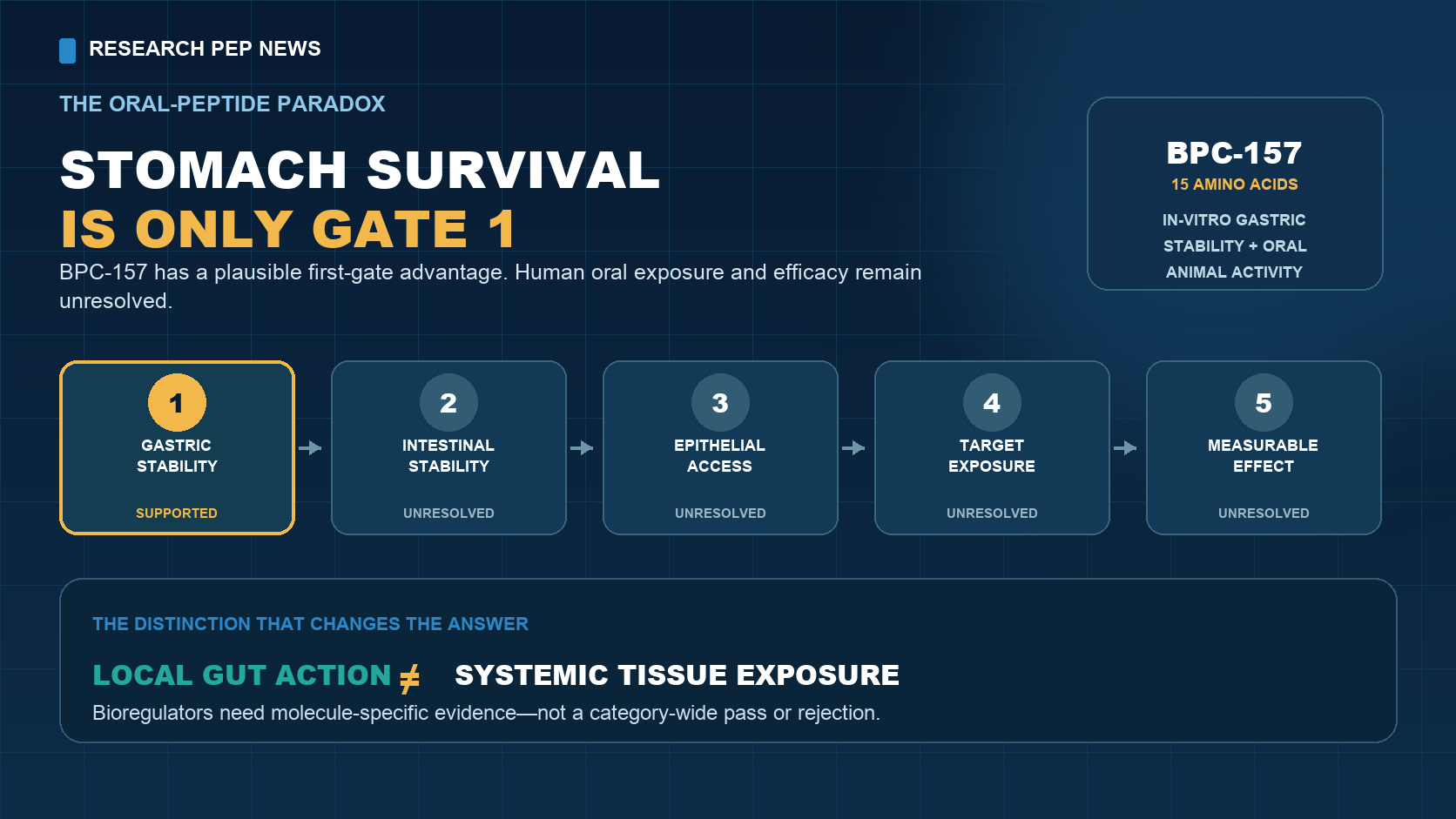
The rat findings support expecting the same direction of repair and adaptation in human intestinal biology. A human study must now determine the magnitude, duration, useful exposure and which post-surgical symptom patterns improve. Route and formulation also matter when translating a laboratory result to products used in the community.
BPC-157 also creates an MS-directed research question
A 2013 rat study combined intestinal injury with cuprizone, a toxin used to model aspects of demyelination. BPC-157 was associated with less motor disability and brain injury over four days while also improving colitis and anastomotic healing.
That result supports testing whether BPC-157’s gut–brain effects extend to MS-relevant biology. Because cuprizone models toxin-driven demyelination rather than the full autoimmune, relapsing or progressive disease, the next step is independent replication in representative MS models followed by a phenotype-defined human trial. Independent replication is especially valuable because much of the current BPC-157 literature comes from one research network.
The existing human BPC-157 signal remains unfinished
The most relevant human efficacy signal remains a 2005 meeting abstract, not a full peer-reviewed paper. In its July 2026 briefing review, FDA staff described 53 people with mild-to-moderate ulcerative colitis randomized to a BPC-157 enema or placebo for two weeks. Forty-six completed the study.
The abstract omitted critical details about eligibility, the disease-activity endpoint, statistics and follow-up, so it leaves the efficacy question open. FDA staff also found that the human ulcerative-colitis literature had not yet tested oral, subcutaneous, nasal or transdermal BPC-157. The important distinction is that BPC-157’s human gut efficacy remains unmeasured by a fully reported trial; it was not disproven.
KPV targets a different part of the gut problem
KPV is the three-amino-acid sequence lysine-proline-valine derived from the end of alpha-melanocyte-stimulating hormone. Its most persuasive gut study is a 2008 Gastroenterology paper that combined human intestinal epithelial and immune cell lines with two mouse models of colitis.
The researchers found that the peptide transporter PepT1 moved KPV into cells. Once inside, KPV reduced NF-κB and MAP kinase signaling and lowered pro-inflammatory cytokine output. In mice given DSS-induced colitis, oral KPV reduced weight loss and cut colonic myeloperoxidase activity—an indicator of neutrophil infiltration—by about 50%. It also improved histology and inflammatory gene expression in both DSS and TNBS colitis models.
That makes KPV an inflammation hypothesis more than an anatomical-repair hypothesis. If a post-surgical patient has objective mucosal inflammation, the pathway is relevant. If the main problem is missing ileum, bile-acid loss or neurogenic constipation, lower inflammatory signaling may not address the principal driver.
The newest KPV research changes the formulation question
A 2026 Science Advances study starts from an important problem: ordinary oral peptides can be degraded and poorly absorbed. Researchers built an inflammation-responsive prodrug called proKPV. In mice with colitis, it produced 3.8-fold greater colonic accumulation than free KPV and stronger effects at a 20-fold lower peptide-equivalent exposure.
That is encouraging for KPV as a molecular starting point. It also warns against treating every “KPV” product as equivalent. The successful material was an engineered conjugate designed for gastrointestinal stability, mucus penetration and release at inflamed tissue—not an ordinary capsule, injection or blend. Direction of effect may survive translation while formulation, exposure and magnitude change completely.
The combination hypothesis is scientifically interesting
Research Pep News’ working hypothesis is this: in a carefully selected post-resection population with objective mucosal inflammation or impaired intestinal adaptation, BPC-157 could support repair and adaptive remodeling while KPV could reduce inflammatory signaling. If the mechanisms are complementary, the combination could improve both tissue-level markers and day-to-day gastrointestinal function more than either peptide alone.
That hypothesis is strong enough to move into a direct combination study. Existing experiments establish the two component mechanisms separately; the next experiment should test whether they add, overlap or interact in a post-resection model before advancing to a phenotype-selected human trial. “Synergy” is the measurable prediction—not a prerequisite for asking the question.
Community reports are a signal, not the denominator
The community pattern is real enough to study. Recent BPC-157 discussions repeatedly pair the peptide with KPV for gastritis, inflammatory bowel symptoms, regularity and generalized “gut healing.” In one recent thread, participants described calmer symptoms and improved regularity. Those self-reported field signals connect directly to the repair-plus-inflammation model and identify outcomes a trial can measure.
These reports are self-selected, diagnoses and products are rarely verified, and many people use several compounds at once, so they cannot estimate response rates. Their value is hypothesis generation: they show which symptom patterns recur and deserve prospective measurement.
The regulatory story changed—but the evidence standard did not
In July 2026, the FDA’s Pharmacy Compounding Advisory Committee recommended BPC-157 and KPV for inclusion on the 503A Bulks List, alongside several other peptides. As Research Pep News reported, that advisory vote did not approve either peptide as a drug or validate the medical claims made for it.
FDA staff’s pre-meeting reviews placed both peptides at the translational stage: human safety characterization for BPC-157 is still incomplete, and KPV awaits its first published human-use study. The agency also identified research questions involving identity, impurities, aggregation and immunogenicity. A future compounding pathway could improve clinician involvement and product oversight while the necessary trials are developed.
What a friend can usefully bring to her doctors
The most valuable suggestion is not a dose or a stack. It is a sharper clinical question. A person with MS and prior bowel resection can ask her gastroenterologist and MS clinician to review:
- the operative report: exactly what segment and how much bowel were removed;
- whether the terminal ileum, ileocecal valve and colon remain in continuity;
- whether the symptom pattern suggests neurogenic constipation, rapid transit, bile-acid diarrhea, bacterial overgrowth, obstruction or active inflammation;
- hydration, weight trend and laboratory markers of anemia, B12, iron, folate, fat-soluble vitamins, magnesium and other deficiencies;
- current MS therapies and other drugs that could affect motility, immunity or peptide safety;
- whether any legitimate clinical trial or monitored research pathway fits her anatomy and diagnosis.
Severe dehydration, persistent vomiting, fever, gastrointestinal bleeding, a swollen abdomen, inability to pass stool or gas, fainting or rapid unintended weight loss require prompt medical assessment rather than experimentation.
The study that could answer the question
A useful trial should not enroll “people with gut issues” as one group. It should enroll adults with stable MS and documented bowel-resection anatomy, then stratify them by objective phenotype: inflammatory, malabsorptive, neurogenic or mixed.
A four-arm study could compare standardized BPC-157, KPV, the combination and placebo under clinical monitoring. Prespecified outcomes should include stool frequency and consistency, abdominal symptoms, hydration, body weight, nutrient status, fecal calprotectin, intestinal permeability or endoscopic markers where appropriate, and validated quality-of-life measures. Neurologic status, MS disease-modifying therapy, infections, clotting, liver signals, immune reactions and product impurities would need active monitoring.
The clearest prediction is not that every person improves. It is that participants with inflammatory or maladaptive features improve more than those whose symptoms are predominantly neurogenic or caused by irreversible loss of absorptive surface—and that the combination outperforms either peptide only if the two mechanisms add rather than duplicate each other.
The bottom line
BPC-157 and KPV deserve serious gut research. BPC-157 has unusually relevant animal findings in intestinal anastomosis and massive small-bowel resection. KPV has an elegant inflammation-targeting mechanism and reproducible mouse-colitis signals, with newer delivery science showing how much formulation may matter. Community reports provide a recurring human signal worth testing.
For a person with MS after bowel surgery, however, “gut healing” is too broad to be a diagnosis or a promise. The exciting question is not whether the peptides are universally good for the gut. It is which post-surgical biology they can change, in which patient, with which formulation, and by how much. That is a hypothesis strong enough to take seriously—and specific enough to test.
Research status: BPC-157 and KPV are not FDA-approved treatments for multiple sclerosis, short-bowel syndrome or post-surgical digestive symptoms. Products labeled “for research use only” are not approved for human use. This article is educational reporting and does not recommend self-treatment or changes to prescribed MS or gastrointestinal care.
This staff report was prepared for Research Pep News and is presented as news and educational information, not medical advice.