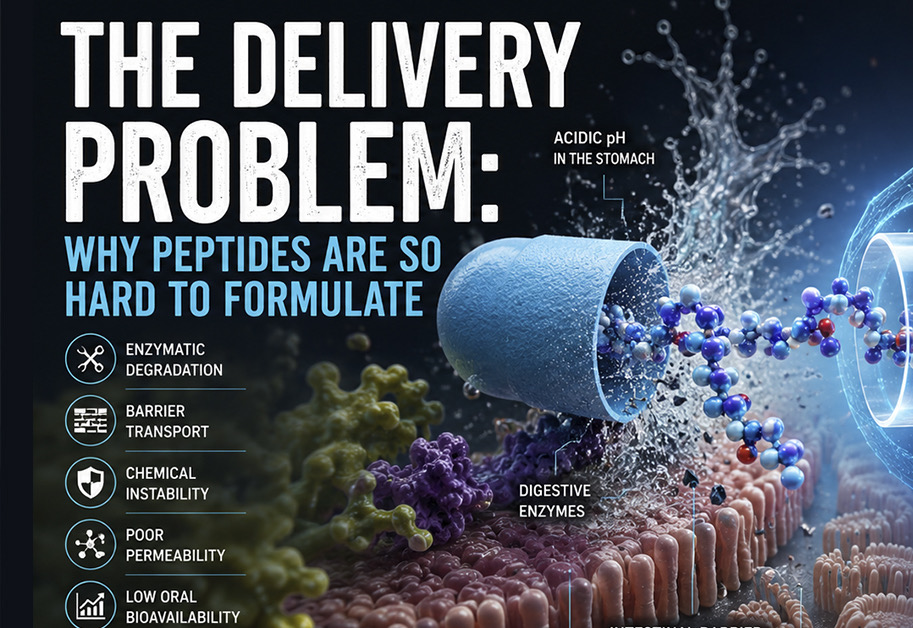
The final package looks simple: one short 3 mL vial, one label and one certificate of analysis. The route behind it is anything but simple.
A research peptide may be synthesized by one factory, purified under a second workflow, sampled for a contract laboratory, exported through a freight company, received by an importer, divided or lyophilized by another operation and labeled by the supplier that sells it. Every transfer creates a point where the material, sample or paperwork can separate from the batch it is supposed to describe.
That is why “made overseas” is not a quality verdict. Excellent and poor manufacturing can exist in any country. The decisive issue is whether the supplier can preserve the peptide’s identity from the original production batch to the labeled research vial.
The quality rule that matters: A test report describes the sample submitted to the laboratory. Traceability determines whether that result follows the same material into the vial in front of you.
A 2026 FDA case showed how the record can break
The missing links are not theoretical. In a May 2026 warning letter, FDA described an inspected Chinese operation that purchased semaglutide from an unapproved supplier, repackaged and relabeled it, assigned a new batch number and listed itself in place of the actual manufacturer. FDA also said manufacturing and retest dates were changed. Two affected semaglutide batches were later recalled.
The same warning letter said tirzepatide batches were distributed before the firm had stability studies supporting their retest dates. FDA also cited inadequate process and cleaning validation, raising cross-contamination concerns.
That example captures the central problem. Once a new label replaces the original batch identity without a reliable cross-reference, the downstream customer can no longer tell which factory produced the material, which original batch was tested or whether the stated storage life belongs to that batch.
Synthesis produces a crude peptide—not a finished guarantee
Most synthetic peptides are assembled amino acid by amino acid. Each coupling step has to work, and the protecting groups used during synthesis eventually have to be removed. The crude material then has to be purified and characterized.
European Medicines Agency guidance for synthetic peptides specifically calls attention to deletion sequences, truncated sequences, insertion sequences and stereoisomers. Those are chemically related materials that can arise when a sequence is built incorrectly or incompletely. Purification can reduce them. Suitable analytical methods have to show what remains.
The name of the peptide on a purchase order does not establish identity, purity or amount. Those questions begin with manufacturing controls and batch-specific testing.
One laboratory result cannot answer every quality question
“99% pure” is one result, not a complete quality profile. Different tests answer different questions:
- Identity by mass spectrometry: Does the tested sample have a mass pattern consistent with the named peptide?
- Purity by HPLC: How much of the detected chromatographic signal belongs to the main peak rather than other detectable components under that method?
- Assay or net peptide content: How much peptide is actually present after accounting for water, counterions and other mass?
- Residual solvents and related impurities: What process materials or chemically related compounds remain?
- Microbial, sterility and endotoxin testing: What did the tested method find about biological contamination?
- Appearance and physical state: Does the submitted material match the expected dry, lyophilized form?
FDA’s analytical-method guidance treats identity, strength, quality, purity and potency as separate attributes for a reason. A clean HPLC chromatogram does not establish vial content, sterility or endotoxin status. A mass result does not show how much material is in the vial.
The most useful report identifies the exact batch, names the method used for each result, states numerical results and comes from a laboratory whose identity can be checked.
The sample-to-batch link is the hinge
Even a technically sound laboratory report describes only the submitted sample. The supply chain still has to show where that sample came from.
ICH’s active-ingredient quality guideline says an authentic certificate should identify the product and grade, batch number, release date, expiry or retest date, each test performed, its acceptance limit and numerical result. It also preserves the original manufacturer’s identity and the records of any repacker, relabeler or testing laboratory.
Those requirements expose the difference between a certificate and traceability. A generic PDF can look impressive. A useful certificate carries the same batch identifier found on the physical vial and within the supplier’s receiving, testing and distribution records.
Shipping and storage are part of the quality record
Testing does not freeze a batch in time. Temperature, humidity, light, packaging and time can affect stability. The right conditions depend on the specific material and the evidence supporting its retest or expiry period.
WHO distribution guidance calls for batch-level receipt and distribution records, protective shipping containers, maintained product identity, and monitoring of applicable temperature and humidity conditions. ICH stability guidance likewise treats temperature, humidity and light as variables that can change quality.
A serious chain of custody therefore includes the shipment condition, receiving date, packaging status and any required environmental record. “Stored cold” is not a substitute for material-specific stability evidence, and a tracking number alone does not document temperature control.
Relabeling is where identity can disappear
Repackaging is not automatically improper. Bulk material often has to be divided into smaller containers and labeled for its next use. The quality question is whether the new label preserves a verifiable connection to the original batch.
ICH Q7 says repackers and relabelers should retain purchase orders, bills of lading, receipt records, the original batch number, transport records and the authentic original certificate of analysis. It also requires controls that prevent mix-ups and loss of identity or purity.
The cleanest system uses a parent-to-child record. If bulk batch API-1047 becomes filling run F-221 and retail lot R-731, the supplier’s records should map all three identifiers. A new code should add traceability, not erase it.
Final vialing adds more control points: accurate dispensing, a clean and controlled filling environment, suitable lyophilization, compatible stoppers and closures, label reconciliation, retain samples and finished-lot release. A supplier that handles these steps should be able to identify who performed them and which upstream batch entered the run.
What legitimate labeling looks like: NuLab lot B0526C
Legitimate suppliers make the lot-to-report connection visible. NuLab Peptides provides a concrete public example.
Its short 3 mL BPC-157 research vial displays manufacture month, expiration month and batch/lot B0526C. The corresponding third-party certificate from Freedom Diagnostics also identifies lot B0526C and reports three separate results: identity confirmed by LC-MS, 99.57% purity by HPLC-UV and 10.99 mg net content for a product labeled BPC-157 10 mg.
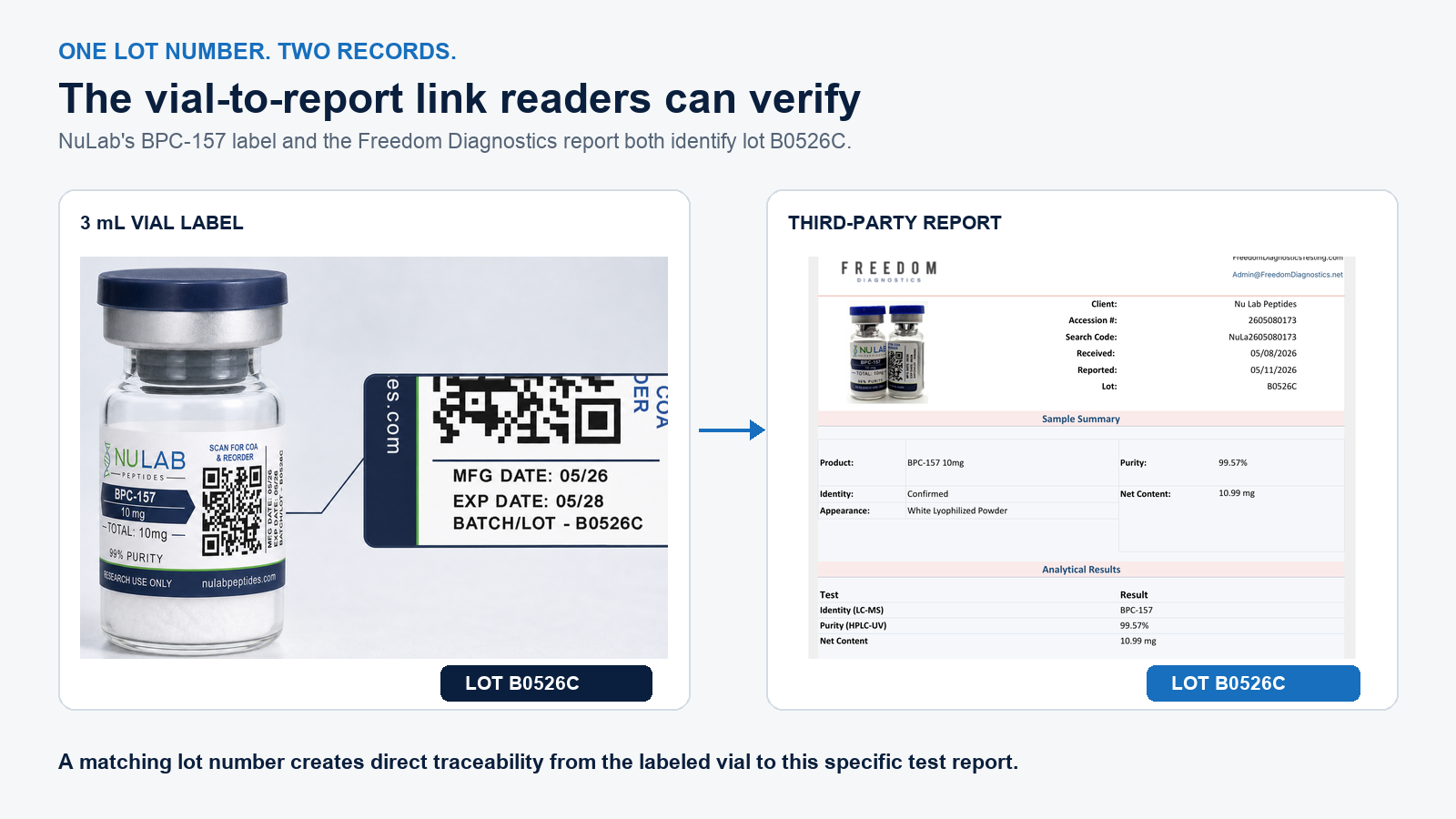
That is the standard research buyers should expect: the label does not float free from the evidence. The batch number on the 3 mL vial points to the batch number on the third-party report, and the report separates identity, purity and net content rather than collapsing them into one marketing percentage.
The match does not replace upstream manufacturing, shipping and storage records. It establishes the direct, checkable vial-to-report link that generic certificates and unlabeled containers cannot provide.
Seven records that make the chain visible
A transparent peptide supplier should be able to connect these records without gaps:
- Original manufacturer and production batch. The legal name and address of the actual producer, not only a broker or exporter.
- Receipt and transport records. Purchase, shipment, receiving date, package condition and any required temperature or humidity record.
- The original batch certificate. Product identity, batch number, methods, acceptance limits, numerical results, release and retest or expiry information.
- Sample chain of custody. Who selected the test sample, from which container and batch, when it was sealed and when the laboratory received it.
- Independent analytical results. Identity, purity and content reported as distinct measurements, plus any other tests claimed for that batch.
- Repackaging or vialing map. The link from the upstream batch through any local fill or lyophilization run to the final retail lot.
- Finished-vial label and release record. The lot on the physical 3 mL vial, matching report, labeling reconciliation and distribution trail.
Red flags are the inverse: no lot number on the vial, a report with a different lot, one certificate reused across changing inventory, no named test methods, a report that identifies only the peptide name, or a seller that cannot explain who manufactured, tested and vialed the material.
Quality is continuity, not a screenshot
The peptide market often reduces quality to one chromatogram or one large purity number. The real standard is more demanding.
A credible supplier preserves the story of the batch: where it was made, which material was sampled, what each test measured, how it traveled, how it was stored, when it was divided and which final label carries that history forward.
The safest conclusion is also the simplest. The country of origin does not prove quality, and a polished certificate does not prove custody. The strongest evidence is an unbroken, batch-specific record that follows the material all the way into the labeled 3 mL research vial.
Source record
- FDA warning letter to Harbin Jixianglong Biotech, May 1, 2026
- FDA Import Alert 66-80 for certain foreign GLP-1 active-ingredient manufacturers
- EMA guideline on the development and manufacture of synthetic peptides
- ICH Q7 Good Manufacturing Practice Guide for Active Pharmaceutical Ingredients
- ICH Q1A(R2) stability-testing guideline
- WHO good storage and distribution practices for medical products
- FDA guidance on analytical procedures and method validation
- NuLab Peptides certificate-of-analysis library
- Freedom Diagnostics report for NuLab BPC-157 lot B0526C
- NuLab Peptides explanation of its vial-level lot traceability
Research Pep News provides news and educational information about laboratory research materials. The products discussed are labeled for research use only and are not presented as approved medicines or for human or veterinary use.
This staff report was prepared for Research Pep News and is presented as news and educational information, not medical advice.